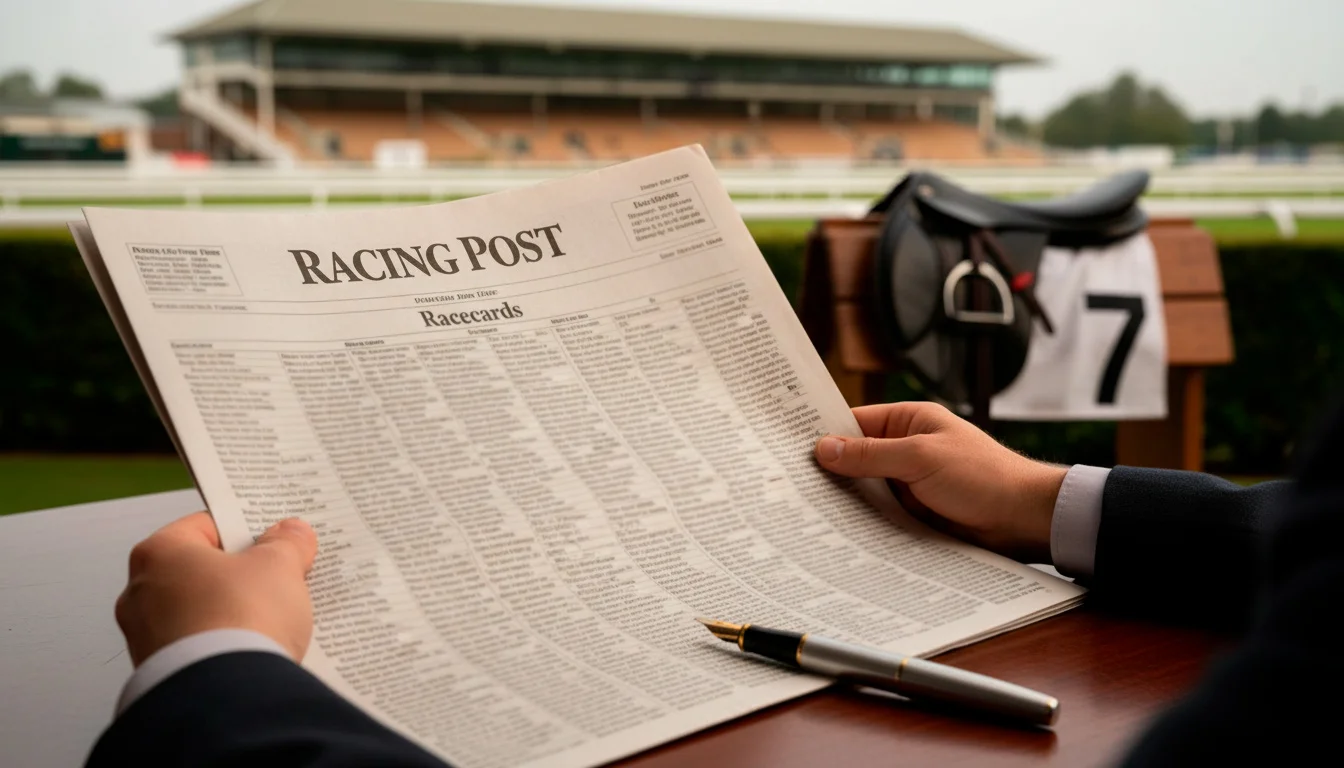
Each-Way Horse Racing Bets and Payout Rules
 Available in US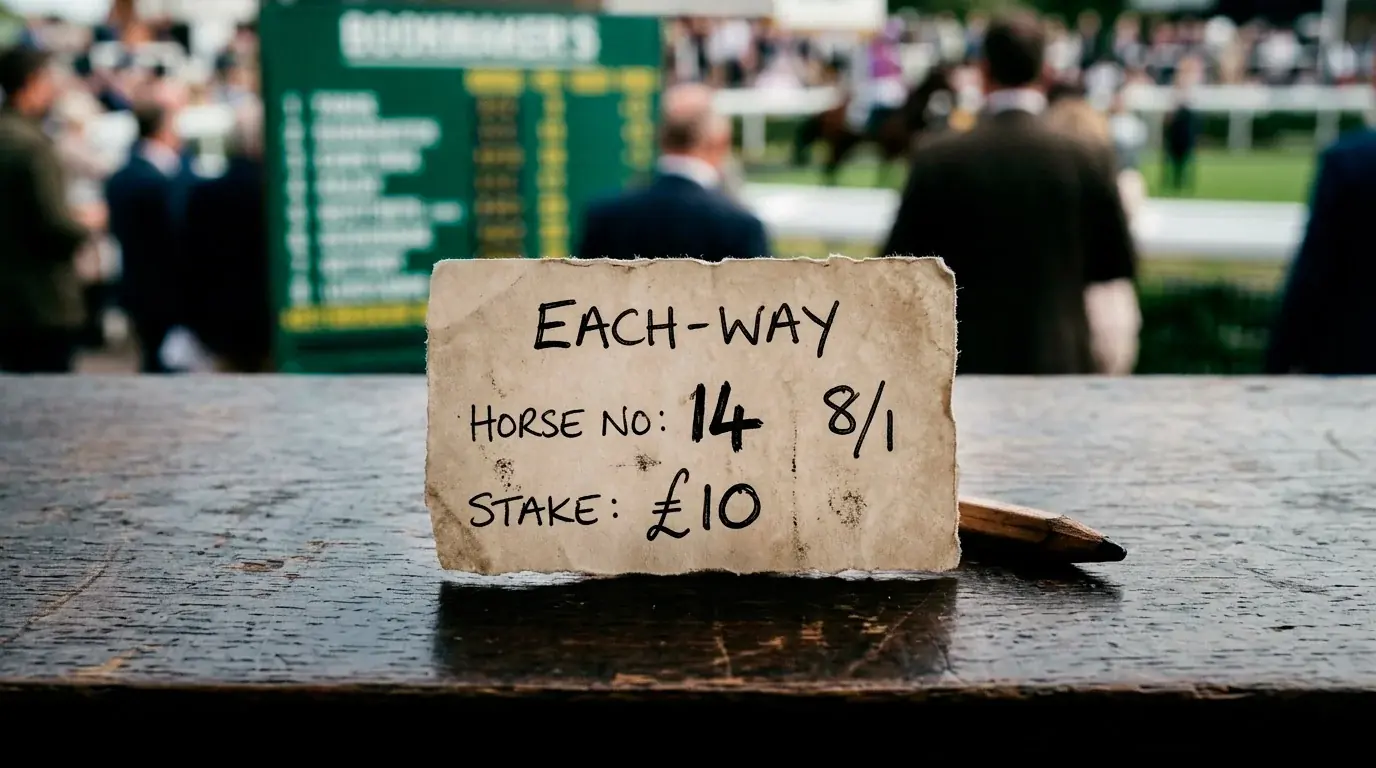
Two punters back the same horse in the same race at the same price. One collects £62. The other collects nothing. The difference between them is not luck, not timing, not which operator they used. It is settlement — the handful of rules that kick in after the line is crossed and quietly decide whether your bet was a bet at all. Each-way terms, Best Odds Guaranteed, Non-Runner No Bet, Rule 4 deductions, dead heats, voids: these are the tools that determine what your pound actually buys.
I spent my first three years in the industry thinking of odds as the thing that mattered. I was wrong. The punter who understands that 4/1 board price with BOG active and NRNB extended is a fundamentally different bet from 4/1 at a shop counter without either protection is the punter who consistently collects more. A £10 SNR free bet on a handicap horse, won at 8.0, with four extra places courtesy of an ongoing promo, can deliver £35 where an identical bet without extra places would deliver £0. This piece walks through the settlement architecture from first principles: each-way anatomy, field-size thresholds — four places at 1/4 odds on handicaps with 16+ runners is the baseline, and that single rule reshapes expected value across festivals — BOG, NRNB, Rule 4, dead heats, voids, and a set of worked examples that tie everything together.
If multiple horses finish in a tie for a place, your returns will be subject to standard dead heat rules in UK horse racing applied by the bookmaker.
Table of Contents
- Calculating Payouts for UK Each-Way Horse Racing Bets
- Place terms and the field-size thresholds that quietly shape your stake
- BOG mechanics: which price actually locks in, and when
- BOG with free bets: why the token rarely gets the upgrade
- Non-Runner No Bet: the ante-post lifeline
- Rule 4 deductions: the silent tax on your winnings
- Dead heats and voids: when the race ends without a clean result
- Four settlement scenarios worked through to the penny
- Settlement as the hidden edge most punters never calculate
Calculating Payouts for UK Each-Way Horse Racing Bets
An each-way bet is not one bet with a safety net. It is two bets, placed simultaneously, at one combined stake. A £10 each-way on a horse at 8.0 with 3 places at 1/5 odds is: £10 on the horse to win at 8.0, plus £10 on the horse to place at a fractional price of 8.0 ÷ 5 = 1.6. Total stake: £20. That is the first correction I make when explaining the format to a new punter — the slip says “£10 each-way” but you are committing £20 of bankroll.
The settlement logic follows from the structure. If the horse wins, both halves pay out: the win half returns £10 × 8.0 = £80, the place half returns £10 × 1.6 = £16. Total return £96 from £20 staked, net profit £76. If the horse places but does not win, only the place half pays: £16 returned, £10 win stake lost, net profit £6. If the horse finishes outside the places, both halves lose: £20 staked, £0 returned, net loss £20.
Where this gets uncomfortable is on short-priced each-way bets. A horse at 3.0 each-way — sometimes called a “skinner” bet — looks like it pays back no matter what. It does not. If the place terms are 1/4 on a 3.0 horse, the place portion pays at a fractional 3.0 ÷ 4 = 0.75 decimal odds. A £10 place stake returns £7.50 — less than your stake back. Placing without winning on a short each-way still costs you money: total stake £20, place return £17.50, net loss £2.50. The industry rule is to avoid each-way bets on any horse priced shorter than 5.0 if the place fraction is 1/4, or shorter than 4.0 if 1/5, unless you have a specific reason. The maths simply does not work.
Each-way on extra places promotions changes the value calculation entirely. The standard handicap with 16+ runners pays 4 places at 1/4. Extend that to 5 or 6 or 7 under an Extra Places promo — which Sky Bet ran on roughly £10m of Cheltenham 2026 payouts — and you are buying a larger place pool at the same stake. On a 12/1 horse finishing fifth in a standard 4-place race, you collect £0. Same horse, same position, under Extra Places to 5, and you collect the place portion at 1/4 of 12/1: stake £5 returns £5 × (1 + 12/4) = £20. That swing from zero to twenty pounds on one horse one position is the single largest repeatable value event in festival punting.
A free bet used each-way is rare but worth mentioning. Most operators block free bet tokens from each-way use, treating the token as single-bet only. Where each-way is permitted, the token value is usually split: a £10 token becomes £5 each-way, not £10 each-way. Read the “use” mechanic of the token in the T&Cs before you try to deploy it each-way on a 12-runner handicap. I have seen punters assume the token doubles up and discover at settlement that it did not.
Place terms and the field-size thresholds that quietly shape your stake
The number of places paid on a race, and the fraction of the win odds used to calculate place returns, are not arbitrary. They follow a schedule tied to field size and race type. Two to four runners — no place betting is offered; it is win-only. Five to seven runners — two places at 1/4 odds. Eight to fifteen runners — three places at 1/5 odds on non-handicaps and flat races. Sixteen or more runners on a handicap — four places at 1/4 odds. These thresholds are the spine of the each-way market.
The field-size sensitivity is why the average Premier Fixture field matters. Flat runs at an average of 11.02 runners, jumps at 9.41 across the 2025 Premier book. That average sits squarely in the 8-15 band — three places at 1/5 — which means most Premier Fixtures offer narrower each-way terms than a competitive handicap at a Saturday festival meeting. A £10 each-way on an 8-runner hurdle at 10.0 with 3 places at 1/5 pays £20 on a place — 10.0 × 1/5 = 2.0, and £10 stake × 2.0 = £20. Respectable. A £10 each-way on a 16-runner handicap at 10.0 with 4 places at 1/4 pays £25 — 10.0 × 1/4 = 2.5, £10 × 2.5 = £25. The bigger field and better fraction together lift place returns by a quarter, and give you an extra place slot for the same stake.
Extra Places promotions work on top of this schedule. The baseline remains: 16+ runners handicap → 4 places at 1/4. Extra Places extend the number of places paid without changing the fraction. A 5-place promo adds one place at 1/4; a 6-place adds two at 1/4. The fraction does not get better; the probability of hitting a place does. Expected value climbs with the additional slots. My rule: on a 16+ runner handicap with Extra Places to 6 or 7, the each-way option is almost always value against the fixed-odds win market, provided the horse’s genuine placing chance is above roughly 25%.
The subtle place-terms trap is non-runner handling. If the field was 16 at the declaration but two horses are withdrawn before the off, the race runs with 14 declarations. Most operators recalculate place terms downward to match the new size — in this case, back to 3 places at 1/5. You thought you had 4 places at 1/4 on a stake placed pre-withdrawal. You do not. Check the operator’s withdrawal-recalculation policy in their racing rules. A handful of bookmakers honour original terms on bets placed before the withdrawal; most adjust.
Extra Places are the marketing layer on top of the baseline place schedule, but BOG is a different beast — it works on the price, not the place count. Worth understanding one before moving to the other.
BOG mechanics: which price actually locks in, and when
Best Odds Guaranteed is a promise that if the starting price — the official SP declared at the off — is greater than the price you took when you placed your bet, the bookmaker pays out at the higher price. You never lose on drift. In a market where roughly £50m of bet365 payouts during Cheltenham 2026 flowed through BOG improvements alone, the scale of this promise is material. But BOG has edges and exclusions that matter.
The price that locks in is almost always either the board price at placement or the SP, whichever is higher at settlement. The “board price” is the price displayed on the operator’s site at the moment you placed the bet. If you took 5.0 at 9am and the SP came in at 6.0, BOG pays you at 6.0. If you took 5.0 and SP came in at 4.0, you keep 5.0 — BOG never costs you the price you took. The direction of protection is asymmetric: you always get the better number, never the worse.
When does the price lock? There is no single answer across the industry, which is why T&Cs vary. Some operators lock the price at bet placement — what you take is what you get, upgraded only if SP drifts higher. Others lock at the “off” — the moment the stalls open — using whatever board price was live at that instant as the floor. A small minority use a morning-price reference, usually the 8am tissue, which means that drifting horses between 8am and the off are protected but shortening horses between those two moments are not. The default I plan around is board-price-at-placement, with upgrade to SP if SP is higher. That is the cleanest mental model and matches about two-thirds of UK licensees.
BOG does not apply to every market. Ante-post bets — wagers placed before final declarations are published — almost never carry BOG, because there is no meaningful SP reference before the day. International racing is often excluded, because overseas tracks do not always publish an SP on the timescales UK operators need. Some operators exclude specific markets: forecasts, placepot pools, match bets. Always check the “BOG eligibility” line in the promotion T&Cs, especially on free bet tokens — the token exclusion is almost universal.
A detail that becomes important during festival weeks: BOG activation windows. Several operators turn BOG on at 8am on the day of a race, not 24 or 48 hours ahead. If you place an ante-post bet at 7:45am, you do not get BOG. Place the same bet at 8:15am and you do. During Cheltenham or Grand National week, when morning boards update rapidly, the 15-minute difference between 7:45 and 8:15 can be several hundred basis points of price movement protected or unprotected. Set a calendar reminder.
BOG with free bets: why the token rarely gets the upgrade
Here is the common disappointment. Punter takes a 5.0 price with a free bet token, horse drifts to 7.0, horse wins. Expecting BOG to pay at 7.0, the punter checks the balance and sees a settlement at 5.0. Nothing has gone wrong — BOG simply did not apply to the token. This is the default across most UK operators.
The underlying logic is economic. BOG is expensive to the bookmaker because drift at SP is a systematic pattern on certain types of races — weak handicaps, cluttered novice chases — and the operator models the cost of extending BOG across the full book of bets. Extending it to free bets too would double the promotional cost per token redeemed, and the marketing value of the welcome offer does not justify the doubled cost. So the T&Cs exclude tokens from BOG.
There are exceptions. A few operators, usually those making a play for a more informed market segment, extend BOG to tokens as a differentiator. Where this applies, the compound value of the welcome offer climbs sharply — a £30 free bet pool with BOG extended to tokens is worth roughly 15-20% more than the same pool without. Read the token T&Cs specifically, not just the BOG page. The two documents sometimes contradict, and the token T&C is almost always the binding one.
A related trap: some operators extend BOG to tokens but cap the upgrade at a specific price or margin. A token placed at 5.0 on a horse that drifts to 12.0 might get upgraded to 8.0 rather than 12.0, under a “BOG cap” clause. This is particularly common on operators running high-value enhanced promotions. Check the token-stage cap as well as the BOG cap — they are often different numbers.
The workaround, where BOG is excluded from tokens, is to take a board price that you believe will hold or shorten rather than drift. If you expect the horse to drift, you are better off with a cash stake at the same price because that stake will be upgraded under BOG. Token stakes belong on horses where the board price is a genuine value number that you do not expect to drift further. This changes the staking logic compared to cash bets — token placement is more about locking in value than about protection.
Non-Runner No Bet: the ante-post lifeline
Ante-post betting without Non-Runner No Bet is a one-way ticket. You back a horse for the Grand National in October, weeks or months before final declarations, at a price of 20/1. If the horse is withdrawn before declaration stage — injury, poor prep, a change of connection — your stake disappears. No refund, no settlement, nothing. Ante-post was historically priced on the understanding that non-runner risk was baked into the price. The tail-risk premium is significant on races with 40+ potential runners stripping down to 34-38 declarations.
NRNB flips that logic. With NRNB active, a bet on a horse that is withdrawn before the race runs refunds the stake as if the bet had never been placed. The premium price you took is gone — you do not get to transfer the money to a different horse at the same price — but the stake is returned. That is the ante-post lifeline. The punter gets the upside of the early price without the downside of the disappeared horse.
NRNB activation on major future events follows a predictable calendar. Grand National NRNB typically switches on in early to mid-March, a few weeks ahead of the April race, and stays on through the weights reveal and declarations. Cheltenham Festival NRNB usually starts 4-6 weeks out. Royal Ascot NRNB tends to activate closer to the June meeting, often the week before. The exact dates vary by operator and by year, but the pattern is consistent: NRNB is a late-stage ante-post protection, not a from-the-moment-the-market-opens protection. Bets placed before NRNB activates are exposed to the full non-runner risk.
Some operators run NRNB concessions earlier for specific horses — a high-profile runner guaranteed to go to post, for example — rather than the full field. These individual-horse NRNB concessions are worth tracking on festival countdowns. A 33/1 ante-post price with individual-horse NRNB is a meaningfully different bet from the same price without.
There is an interaction with free bets worth flagging. Free bet tokens used on ante-post markets typically do not refund on non-runner — the token burns rather than re-credits. Cash stakes refund to balance; tokens usually do not. Before you stake a £10 token ante-post on Cheltenham, check whether the operator’s NRNB policy extends to token stakes. In most cases it does not, and the token is better deployed on a market closer to the off where the non-runner risk is lower and the placeholder protections of BOG and Extra Places apply.
Rule 4 deductions: the silent tax on your winnings
A horse is withdrawn between bet placement and the race. The withdrawn horse was a 2.0 favourite. The race now runs with a different favourite at a shorter effective price. Every other horse in the book suddenly has a different probability of winning, because one rival is removed. Rule 4 — named after the Tattersalls’ Rule 4c that formalised it — is the mechanism the industry uses to adjust your payout to reflect the new book. It is a deduction on winnings, applied on a scale tied to the withdrawn horse’s price.
The deduction scale is fractional but straightforward. A horse withdrawn at 1/9 to 2/11 triggers a 90p deduction per pound won. At 2/7 to 1/3, 80p. At 2/5 to 8/15, 70p. At 4/7 to 8/13, 65p. At 4/6 to 4/5, 55p. At 5/6 to 11/10, 50p. And so on down the scale, reducing as the withdrawn horse’s probability drops, to 5p at 10/1-14/1. At prices above 14/1, no deduction applies — the withdrawn horse was not considered to have a meaningful chance in the original book. These are the published Tattersalls deductions and they are applied uniformly across the UK industry.
The arithmetic: you bet £10 at 8.0. A 2/1 horse is withdrawn before the race. Your horse wins. The Rule 4 deduction at 2/1 (decimal 3.0) is typically 25p in the pound on winnings. Your winnings of £70 (£10 stake × 8.0 = £80, less stake = £70) are reduced by 25% — so £70 – £17.50 = £52.50. Total return £52.50 + £10 stake = £62.50. Had there been no withdrawal, you would have collected £80. Rule 4 cost you £17.50 on a race you won. That is the silent tax.
Multiple withdrawals compound. Two horses withdrawn, deductions stack up to a maximum combined 90p in the pound. A rare three-horse withdrawal scenario can erase almost all winnings, though the race itself may be declared void if too many withdrawals destabilise the market. Rule 4 does not apply to ante-post bets — the whole point of ante-post pricing is that the market is not yet settled, and withdrawals before the final declaration stage are absorbed into the price. Once the bet is placed at board price on race day, Rule 4 is live.
Dead heats and voids: when the race ends without a clean result
A dead heat is when two or more horses cross the line indistinguishable on the photo. In UK racing, dead heats are resolved by dividing the stake across the tying horses and paying out proportionally. If your horse dead-heats with one other horse for the win, your stake is treated as if half of it won at the full price and half lost. A £10 win stake at 6.0 in a two-horse dead heat returns £30 (half of £60), not £60 in full. The operator is effectively acting as if you staked £5 at 6.0 and £5 on a losing bet.
Dead heats on place portions work the same way. If three horses dead-heat for third place in a 5-place handicap, the third-place returns are split three ways. Your £10 place stake at 1/4 of 10.0 (so 3.5 decimal) returns £11.67 rather than £35 — one-third of the full place payout. This is the mechanism most punters forget: dead heats on places are common, especially in big-field handicaps, and they silently haircut your returns by a third or a half.
Void bets are different. A race is declared void when something has gone wrong — too few runners went to post, the starting gate failed, the course was deemed unsafe — and the industry cannot determine a fair result. Voided bets refund cash stakes in full. Free bet tokens, as discussed, usually burn on a void: the token was consumed at placement and is not re-credited. Operators split on this; some re-credit tokens on void, most do not.
One edge case: a race declared void after running — extremely rare, but it happens when a fouled runner affects the outcome of the entire field — triggers a full refund of all cash bets. Ante-post bets on the voided race typically refund too, but only if the void is declared race-of-meeting rather than race-of-individual. Always read the operator’s void-race clause on ante-post wagers; the interpretation varies.
Four settlement scenarios worked through to the penny
The theory lands better with numbers. Four scenarios, each one illustrating a different settlement rule.
Scenario one: straight win with BOG upgrade. £10 cash stake on a horse at 5.0 board price. BOG active at placement. SP comes in at 7.0. Horse wins. Settlement: BOG upgrades to the higher price, so return is £10 × 7.0 = £70, net profit £60. Without BOG, this would have been a £50 return at 5.0 — £10 of BOG value on a single bet.
Scenario two: each-way place on a competitive handicap. £10 each-way (total stake £20) on a 16-runner handicap at 10/1. Place terms 4 at 1/4. Horse finishes fourth. Win half loses (£10 stake gone). Place half pays at 1/4 of 10/1: 10/1 divided by 4 = 2.5/1, or 3.5 decimal. Place stake £10 × 3.5 = £35 return. Total: £35 return on £20 stake, net profit £15. The same bet without the 4-place handicap rule (say 3 places at 1/5 on a non-handicap) would have paid £0 — the place threshold rule alone created the £15 of profit.
Scenario three: Rule 4 deducted payout. £10 cash stake on a horse at 8/1 (9.0 decimal). A 2/1 second favourite is withdrawn before the off. Your horse wins. Rule 4 deduction at 2/1 is 25p in the pound. Winnings = £80 (£10 × 9.0 = £90, less £10 stake). Deduction = £80 × 0.25 = £20. Payout = £80 – £20 + £10 stake return = £70. Without Rule 4 the payout would have been £90. The withdrawal cost you £20.
Scenario four: SNR free bet with Extra Places. £10 SNR token on a 16-runner handicap at 12/1 (13.0 decimal). Extra Places promo extends to 6. Horse finishes fifth. Win half of token is lost. Assume the operator allowed the token each-way (rare): £5 win lost, £5 place at 1/4 of 12/1 = 3.0 decimal, returning £5 × 3.0 = £15. SNR erases the £5 notional place stake, so net cash returned = £10. On a standard 4-place handicap, the same horse finishing fifth returns £0. Apply this pattern across twenty Cheltenham bets over four days and the aggregate is substantial — which is why Sky Bet’s Extra Places liability was £10m-plus across the meeting.
For the wider context on how these settlement rules fit into overall UK free horse racing betting value extraction — including where Levy economics and black-market displacement change the calculus — the pillar analysis connects the threads.
Settlement as the hidden edge most punters never calculate
Most discussions of “value” in racing focus on price. Did you get 6.0 where the fair odds were 5.0? Did you beat the SP? Those questions matter but they are half the picture. The other half is whether the terms of settlement multiplied or eroded that value at the payout stage. As Simon Clare at Entain observed of the Cheltenham Gold Cup day effect, the massive uplift in turnover relative to the rest of the festival is often underappreciated — and a race like the Hunters’ Chase, with so many horses and riders unfamiliar to racing fans, ends up being the seventh biggest betting race of the festival precisely because the competitive field and place terms turn it into a value opportunity for anyone paying attention to the settlement mechanics.
Field size alone can double the effective place pool. BOG alone can add 10-20% to the average cash stake return over a season. Extra Places alone can turn dead money into real returns on three or four bets per festival day. Non-Runner No Bet alone can rescue an ante-post book when connections pull runners late. Rule 4 alone can silently tax winnings by 25% on a race you won cleanly. Compounded across a season, these rules are the largest single source of edge available to a disciplined UK racing punter. The odds are the headline. The settlement is the result.
When exactly does a UK bookmaker lock in the BOG price — at bet placement, at the off, or earlier?
Most UK operators lock the board price at the moment you place the bet, then upgrade to SP at the off if SP is higher. A minority lock at the moment the stalls open, using whatever board price was live at that instant. A smaller group uses an 8am morning tissue price as the reference. Ante-post bets placed before race day almost never carry BOG because there is no meaningful SP reference. Check the specific operator’s BOG page for the locking convention, because the difference between placement-lock and off-lock can matter by several basis points during festival mornings when boards update rapidly.
When does Rule 4 apply and how is the deduction calculated?
Rule 4 applies when a horse is withdrawn between your bet being placed and the race being run. The deduction is a fraction of your winnings only — not your stake — tied to the withdrawn horse’s price. At 2/1 the deduction is 25p in the pound; at 4/1 it is 20p; at 10/1 it is 5p. Above 14/1 no deduction applies. If you bet £10 at 8.0 and a 2/1 horse is withdrawn and your horse wins, your £70 of winnings is cut by 25% to £52.50, plus your £10 stake returned. Multiple withdrawals compound up to a 90p cap.
What happens to my each-way stake if the race has only 4 runners?
Races with four or fewer declared runners are win-only markets — no each-way betting is offered. If you placed an each-way bet when the race was declared to field at five or more and the field then drops to four before the off because of withdrawals, most operators cancel the place portion of the bet and refund the place stake. The win half of the each-way stays live. A few operators handle this by voiding the full bet and refunding the combined stake, but the industry default is to split: place half refunded, win half carries through at the declared price with Rule 4 deductions applying where the withdrawals justify them.
Do Extra Places promotions stack with Best Odds Guaranteed?
Yes in most cases, but with an important caveat: Extra Places applies to the place portion of an each-way bet, BOG applies to the price. They are independent mechanisms. If your horse finishes fifth in a 16-runner handicap with Extra Places to 5 and BOG active, the place half pays at 1/4 of the higher of board price and SP. The two promotions compound rather than conflict. The caveat is that if either of the promotions excludes free bet tokens — which many operators do for BOG on tokens — the stack applies only to the cash half of the stake. Check both T&Cs before you place, not just the headline promo banner.
Written by the editors at Free Horse Racing Betting. Discover more profitable strategies and daily tips at Free Horse Racing Betting to maximize your returns.