UK Horse Racing Welcome Offers and Sign-Up Bonuses
 Available in US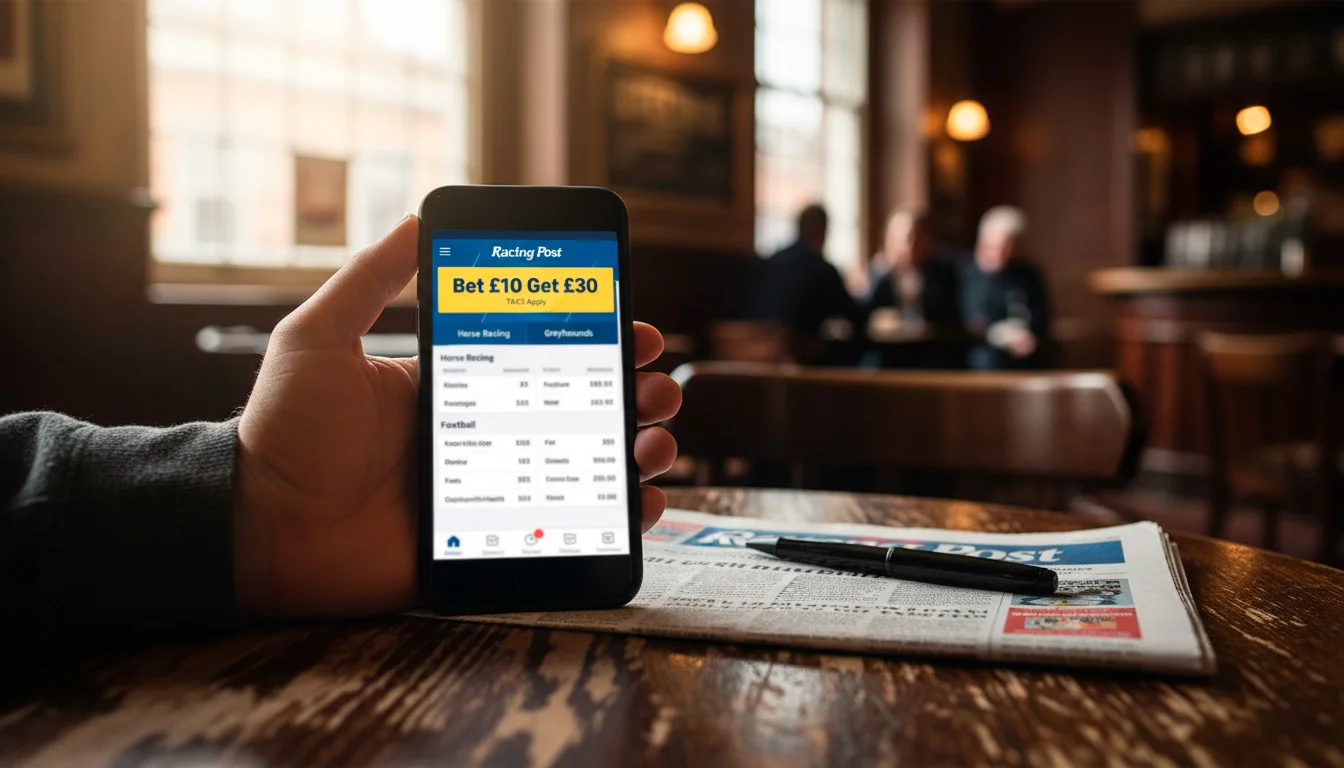
The first thing I do when a new welcome offer lands in my inbox is open the T&Cs and scroll straight to the exclusions. Not the headline. Not the “£30 in free bets” banner. The fine print — because that is where the actual offer lives. Seven years of cashing, fumbling and occasionally losing welcome bonuses on UK racing have taught me one thing: the number on the front of the advert is a marketing artefact, and the number you will realistically extract is something else.
A welcome offer is not a reload, a loyalty freebie, or a festival-specific Extra Places promo — it is a one-time acquisition tool built to move you from “curious” to “first deposit settled.” During Cheltenham 2026, Sky Bet spent around £10m on Extra Places payouts and bet365 put roughly £50m through its Best Odds Guaranteed bucket across four days. Those are the headline industry numbers — but almost none of that money flows to new customers through welcome tokens. The welcome bucket is smaller, more carefully metered, and more aggressively fenced with clauses about minimum odds, expiry windows, and payment methods. Against that backdrop, roughly 24.4m active remote-betting accounts sit on UK operator books, and that pool is not growing — new registrations fell 4.1% year on year across the remote casino, betting and bingo sector.
This piece is a practitioner’s walk-through of the anatomy of a “Bet £10 Get £30” offer: the qualifying mechanics, the minimum odds traps, the SNR logic that erases a chunk of your nominal £30, the wagering rules, the payment-method blacklists, and the actual expected value once you strip the marketing language away. By the end you should know exactly what a welcome free bet on UK racing is worth to you — in pounds, not in banners.
Before claiming any bonus, it is crucial to understand how wagering requirements on UK horse racing free bets affect your ability to withdraw winnings.
Table of Contents
- Evaluating Bet £10 Get £30 Horse Racing Welcome Offers
- Why minimum odds of 1.5 are the industry’s quiet compromise
- Stake returned versus stake not returned: the detail that halves your offer
- Wagering, rollover and the trap of bonus funds
- Expiry windows and the exclusions that quietly kill value
- No-deposit offers and why the UK market makes them rare
- The payment method clauses that catch experienced punters
- What a “£30 welcome bonus” is really worth in expected pounds
- What the welcome-offer market really rewards in 2026
Evaluating Bet £10 Get £30 Horse Racing Welcome Offers
I watched a friend deposit £10 last spring, lose the qualifying stake at 1.3 odds, and ring me up two weeks later asking where his free bets had gone. He had never received them. The qualifying bet had been placed below the minimum odds floor — and the offer quietly voided. No email, no banner, no refund. That is the shape of a welcome offer: every step has a tripwire, and every tripwire is explicitly disclosed in the T&Cs that almost nobody reads.
Strip the decoration away and a “Bet £10 Get £30” welcome bonus breaks into four sequential stages. Stage one is registration and first deposit: sign up, pass KYC — the operator is legally required to run identity verification before you stake — and fund the account, usually with a £10 minimum from an eligible method. Stage two is the qualifying bet: stake that £10 at minimum odds, almost always 1.5 decimal, on any eligible market. Racing usually qualifies, though some operators exclude ante-post specials or placepot pools. Stage three is settlement. Once the qualifying bet settles — win or lose — the free bet tokens are credited. Stage four is the free-bet stage itself: you have to actually use the tokens, within an expiry window, under a second layer of restrictions.
What I call the anatomy matters because each operator adjusts the dials differently. I have seen “Bet £10 Get £30” offers that credit three £10 tokens, others that credit one £30 token, and others still that credit £20 in racing-only tokens plus £10 in “bet builder” tokens restricted to football. The product under the banner is not standardised. There is also a mechanical distinction between tokens, cash bonus funds, and enhanced-odds credit. Free bet tokens are usually locked to single-bet use, cannot be split, and are forfeit if unused. Cash bonus funds sit as a wagering balance — you can bet with them, but they obey rollover rules before any winnings are withdrawable. Enhanced-odds credit is a third variant: your £10 stake is boosted to a higher price on a specific market. Tokens dominate UK racing welcome offers, but knowing which of the three formats you hold changes everything about how to deploy it.
One detail that catches new punters consistently: the qualifying bet itself is almost never refundable. If you stake £10 at 2.5 and the horse loses, that £10 is gone. You did not “pay” £10 for the free bets — you placed a real bet. The free bets that follow are additional, not compensatory. The value of the offer is the expected value of the free bets minus the expected loss on the qualifying stake, not the face value of the tokens.
Why minimum odds of 1.5 are the industry’s quiet compromise
Minimum odds of 1/2 fractional — 1.5 decimal — are the single most common qualifying condition in UK welcome offers. The number looks arbitrary until you understand what it is solving for. Set the floor too low and punters game the offer by staking on heavy favourites: they pocket qualifying winnings and still unlock the free bets. Set the floor too high and the qualifying stake becomes a genuine risk, the conversion rate from click to deposit craters, and acquisition cost balloons. 1.5 is the compromise — high enough that roughly one in three qualifying bets loses, but low enough that the offer still looks accessible.
The practical effect on the punter is subtle but important. If you stake £10 at 1.5, your expected return on the qualifying bet alone — assuming the operator’s price reflects roughly fair probability — is close to zero. You are not making a value bet; you are paying a small premium for the right to unlock the free bets. The margin on a binary racing market at 1.5 is typically 2-4%, which means your expected loss on a £10 qualifying stake is around 20-40p. That is the effective “price” of the welcome offer.
Minimum odds also shape how you should choose the qualifying market. In racing, 1.5 is roughly the line between an odds-on favourite and a mild favourite. Most Saturday handicaps will have two or three runners at 1.5 or higher — which sounds like a lot until you remember that the favourite at 1.5 still loses 40% of the time. I have watched too many punters stake on a 1.55 favourite, lose, and then convince themselves the free bets “must be” worth it. They are — but only if you treat the qualifying bet as a deliberate bet, not as a token gesture.
A small practical note: some operators require minimum odds on the free bet stage too, not just the qualifying bet. You get the £30 token, try to stake it on a 1.4 favourite, and the bet is rejected. Read the second-stage minimum odds in the T&Cs — they are often listed separately and can be higher than the qualifying minimum. 1.5 on the qualifier and 2.0 on the free bet is a pattern I see regularly. The 1.5 floor also interacts awkwardly with each-way racing bets: on an each-way qualifier at 8.0, only the win portion of the stake counts toward the £10 threshold, and the place portion at a fraction of 8.0 may not meet the 1.5 floor at all. I have seen qualifying bets voided over this exact confusion. Keep the qualifying bet single, win-only, and safely above 1.5.
Stake returned versus stake not returned: the detail that halves your offer
Here is the single most expensive misunderstanding I see: punters quoting free bet returns as if the stake comes back. It does not. Roughly 95% of UK free bets settle on an SNR basis — Stake Not Returned — and that one acronym changes the arithmetic of every welcome offer on the market.
The mechanic: if you stake a £10 SNR free bet at decimal odds of 5.0, a winning bet returns £40 in cash, not £50. The bookmaker returns winnings only, not the notional stake. Compare that with a cash bet at the same price: £10 at 5.0 returns £50, of which £10 is your original stake and £40 is profit. Functionally, an SNR free bet at 5.0 is worth the same as a cash bet at 4.0 — you always lose the stake component. The higher the price, the less damage SNR does; at 20.0 you lose 5% of the nominal return, at 2.0 you lose 50%.
There is a reason SNR dominates the UK market. From the bookmaker’s perspective, returning the stake turns a free bet into an effective cash gift — the marginal cost per redemption roughly doubles. By withholding the stake, the operator can nominally offer “£30 in free bets” while committing expected value closer to £10-12 once you account for minimum-odds constraints, SNR mechanics, and unused token expiries. The SR format does exist — I see it occasionally on specific enhanced-odds promotions — but it is rare enough in welcome offers that assuming SNR is the safe default.
The strategic implication is sharp. If you want to extract maximum nominal value from an SNR free bet, you have to go to higher prices. Staking a £10 SNR token on a 1.6 favourite is close to pointless — even if the horse wins, you collect £6 profit. Staking the same token on a 6.0 outsider returns £50 if it wins. The outsider wins far less often, but expected value is much closer to the face value at higher prices. My rough rule: stake SNR free bets at 4.0 or higher, on markets where you have a genuine opinion. Anything below 3.0 converts too much of the token value into phantom stake return. On void races, cash bets refund but SNR tokens almost always burn — once placed, the token is consumed. Some operators re-credit tokens on abandoned races, but this varies by T&C.
Wagering, rollover and the trap of bonus funds
Wagering requirements do not usually apply to free bet tokens — a £10 token is either used or lost — but they absolutely apply to bonus funds, and the distinction matters because some welcome offers credit funds rather than tokens. A 1x wagering requirement means you need to stake the bonus amount once before winnings become withdrawable. A 3x means three times. A 5x, which I mostly see on casino-adjacent offers rather than racing-pure bonuses, means your £30 has to be turned over as £150 in stakes before a single pound becomes yours.
How you calculate rollover for horse racing depends on the operator’s contribution table. A £10 bet at decimal odds of 2.0 contributes £10 toward the rollover requirement on most UK racing bonuses — racing bets usually count at 100% of their cash stake. Some operators, however, only count bets at minimum odds of 1.8 or 2.0; a qualifying bet at 1.6 goes through as a normal bet but contributes nothing to rollover. I have seen punters stake hundreds chasing a target only to discover their entire staking pattern failed the minimum-odds contribution rule.
On horse racing specifically, watch out for four wagering traps. First, placepot and Tote pool bets rarely contribute to rollover — the operator has no meaningful margin on pooled bets. Second, some operators exclude each-way bets from rollover contribution, or count only the win portion. Third, ante-post bets sometimes do not contribute until settlement, which for Cheltenham bets placed in January means your rollover clock does not start until March. Fourth, certain “enhanced odds” markets — the 11/4 about a 6/4 horse — are explicitly excluded because they have already been priced as a loss-leader.
A £30 bonus with a 3x rollover at 1.8 minimum odds means you need to place £90 in stakes at 1.8 or higher before any winnings are withdrawable. If your staking pattern averages £10 bets, that is nine bets — a meaningful commitment of bankroll and concentration. The expected value on the rollover stages is negative (you are paying the bookmaker’s margin on each bet), which is why the nominal bonus value always overstates the expected extractable value. Some operators split offers into two tranches: part as a token and part as bonus funds. You receive £20 in free bet tokens and £10 in bonus funds. The tokens play out on SNR logic; the bonus funds play out on rollover logic. These are two different mental models, and mixing them up is how people end up “trapped” with a balance that will not withdraw.
Expiry windows and the exclusions that quietly kill value
The clock starts the moment tokens hit your account, not the moment you read the promotion email. Seven days is the most aggressive expiry I see on UK racing welcome offers, fourteen is common, thirty is the upper end of generosity. Unused tokens evaporate — no credit, no refund, no “sorry we missed you.” I have seen smart punters forget about £30 of tokens because they deposited on a Monday, skimmed the email on Wednesday, and mentally filed the offer under “I’ll do it next weekend.” That next weekend was the eighth day. The tokens were gone.
Seven-day expiries are usually tied to offers that credit tokens immediately on qualifying bet settlement. Fourteen-day expiries are common on offers that split credit across multiple tokens — one £10 today, another at the end of week one, another at end of week two. Thirty-day windows typically appear on larger bonuses. The expiry structure tells you something about the operator’s confidence: short windows are a bet against your attention, long windows are a bet on your engagement.
Exclusions are the other silent value-killer. A standard welcome offer on UK racing will exclude virtuals, pools and Tote markets, in-play bets in some cases, and enhanced-price markets where the price itself has already consumed the margin. Virtuals are excluded because the racing is simulated and the operator effectively controls outcome distribution. Pools and Tote are excluded because the operator does not take margin on pooled bets. Enhanced prices are excluded to prevent stacking — you cannot use a free bet on a 10/1 about a 6/1 horse and print money.
The specific exclusion I watch for most carefully is the “eligible markets” clause. Some operators exclude international racing from welcome free bets, limiting you to UK and Irish meetings. Others exclude specific bet types: forecasts and tricasts are sometimes barred, or acca bets involving more than one race. A few offers exclude specific meetings. Always check the markets list before you open a position. Many welcome offers also explicitly bar use of free bets on markets priced shorter than the stated minimum — a 2/5 (1.4) will be rejected outright; a 4/6 (1.67) is borderline depending on exactly how the floor is written.
No-deposit offers and why the UK market makes them rare
“Get £5 free, no deposit required” — I get this email roughly once a month, and almost every time it is misleading. True no-deposit free bets — where you sign up, get a token, and never fund the account to unlock it — are unusual in the UK regulated market for structural reasons. UKGC licensees are required to run full KYC before crediting any stake-able balance, which means even a “no-deposit” free bet involves mandatory identity checks, and administrative friction per acquired user is comparable to a £10-deposit flow. The economics do not favour giveaways that small.
What usually hides behind “no deposit” marketing is either a bet-and-get structure rephrased, or a bonus conditional on a non-monetary step — verifying a phone number, linking a loyalty account. Occasionally the offer is real: £5 in SNR tokens on one specific race, one-off, expiring within 48 hours. Those micro-promotions exist but are rare enough that if you see “up to £50 no deposit required” on a racing free-bets page, your first instinct should be to check whether the site is UKGC-licensed at all.
This is where the offer topic intersects with one of the more uncomfortable realities of the UK racing market: an estimated £4.3bn a year is staked with unlicensed operators across all sports, with UK-specific racing traffic to unlicensed sites growing rapidly. The sites promising “£100 no deposit free bets” on UK racing are, in many cases, not UK licensees at all. They are offshore operators using inflated bonus values as an acquisition hook, with no regulatory obligation to pay out winnings, no consumer protection if the account is closed arbitrarily, and no recourse if terms are changed retroactively. As Grainne Hurst at the Betting and Gaming Council has put it, balanced regulations and a stable tax regime are the best defence against that black market — parasite operators don’t pay tax, don’t contribute to safer gambling, and don’t put a penny into the Levy. Her framing matters because the free bets on those sites are marketing theatre, not offers you can bank.
The red-flag pattern I teach new punters: if the nominal value of a no-deposit bonus is larger than the value of a standard welcome offer with deposit — £100 no-deposit versus £30 with a £10 deposit — the arithmetic does not work for a regulated operator. No UKGC licensee is burning that much acquisition cost on unverified sign-ups. Either the offer has hidden conditions that reduce its real value to near-zero, or the site is operating outside the UKGC framework. Before you register, check the operator’s licence number on the Gambling Commission’s Register of Licensees. A two-minute check saves the occasional catastrophic mistake. Treat no-deposit free bets as a useful bonus when you find a genuine one from a licensed operator, but do not structure your bankroll around them — the real welcome-offer value in the UK regulated market lives in the bet-and-get format.
The payment method clauses that catch experienced punters
Every serious UK welcome offer excludes Skrill and Neteller from qualifying deposits, and most exclude PayPal, Paysafecard, and certain prepaid card issuers. The reason is historical. Skrill and Neteller were for years the VIP abuser’s payment stack of choice — they allowed rapid account rotation across operators, supported chargebacks in ways that undermined promotional economics, and were associated with disproportionate volumes of promotional abuse. Operators responded by blacklisting those methods from welcome promotions across the board.
The practical problem is that blacklists are not always obvious at deposit time. Some operators flag the method as ineligible only in the T&Cs, deep in a second-level document linked from the promo page. Others flag it at deposit but let you deposit anyway, silently voiding the promotion. I have seen punters deposit via Skrill, place the qualifying bet, wait a day for credit, and then discover the offer was voided at registration because the funding method disqualified the account. No refund, no credit, no reversal.
Check the accepted methods list before you deposit. The cleanest path is debit card or bank transfer — both are universally accepted for welcome offers on every UK licensee I have tested. Credit cards are no longer permitted for gambling deposits in the UK under Gambling Commission rules, so this is not a decision variable. Debit card remains the default and in my experience has the lowest rate of promotion-voiding edge cases.
A final detail that bit me personally: some operators change their payment-method eligibility list mid-campaign, usually after press coverage of abuse on a specific wallet. A method that was eligible Monday can be ineligible Thursday. The T&Cs typically allow the operator to modify the list at any time. The safer move is to deposit within 24 hours of reading the terms, using a method that has been universally accepted on past welcome offers from that operator.
What a “£30 welcome bonus” is really worth in expected pounds
Time to put numbers against the rhetoric. Take a standard “Bet £10 Get £30” welcome offer with minimum qualifying odds of 1.5, three £10 SNR tokens, minimum odds of 2.0 on the free bet stage, seven-day expiry, and standard UK racing market availability. What is the expected pound value to a reasonably attentive punter?
Start with the qualifying stage. £10 at 2.0 on a racing market with typical overround — call it 120% on a mid-sized handicap, inside the industry’s 110-130% band for fixed-odds racing — carries an expected loss of roughly 8-10% on the stake, or about 80-100p. Call it £0.90 of expected loss on the qualifier.
Now the free bet stage. Three £10 SNR tokens carries an effective stake-equivalent value of 50% of face at 2.0 — £5 per token — because SNR erases the notional stake. The maximum practical face value is therefore 3 × £5 = £15. But that assumes 100% staking efficiency at fair odds, which never happens. Realistic extraction depends on what prices you stake at. If you stake all three tokens at 2.0, each token’s expected value is around £2.50, total £7.50. If you stake at higher prices — 5.0 or 6.0 — extractable value climbs toward £12-13, because the SNR penalty shrinks as a percentage of nominal return. So realistic expected value is £8-13 depending on deployment, minus the £0.90 qualifying cost, giving a net extractable value of roughly £7-12 on a headline “£30” offer.
That figure — £7-12 — is the practitioner’s anchor. It is not £30. It is not the “win up to £150” language some affiliates like to quote. It is what a statistically competent punter can expect to walk away with across the full offer lifecycle, assuming average racing market overround of 110-130%, SNR tokens, and no meaningful edge on price. If you bring an edge — genuine information about a specific horse, a better read on the ground, a value assessment on the price — expected value climbs above £12. If you stake impulsively at whatever prices feel right, it can fall below £7.
Two adjustments push value higher. First, operators routinely underprice favourites in competitive handicaps — staking SNR tokens in the mid-field of a 12+ runner handicap at 6.0-10.0 tends to capture marginal value. Second, Best Odds Guaranteed, where it applies to free bets, compounds with the token. One adjustment pushes value lower: tokens not used before expiry return nothing. Roughly 15-20% of welcome tokens go unstaked by ordinary punters — not because they forget exactly, but because “the right race” never quite materialises in the expiry window. Factor that non-redemption rate in and £7-12 drops to £6-10.
If you want the wider context — how welcome offers sit inside the UK free horse racing betting ecosystem, how Levy economics drive operator spend, and where festival-specific promotions fit — the broader analysis connects the threads across the regulated market.
What the welcome-offer market really rewards in 2026
The punters who get paid are the ones who treat welcome offers as a structured exercise, not a bonus hunt. The nominal value of the headline — £30, £50, £100 in free bets — is a marketing artefact, and every successful extraction requires reading past it to the minimum odds, the SNR logic, the expiry clock, the payment-method blacklist, and the market exclusions. Seven to twelve pounds of expected value per welcome offer is not nothing; spread across four or five UK licensees you have never used, that adds up to a meaningful bankroll supplement over a single racing season. But the punter who stakes impulsively collects three or four pounds and wonders why the offer “didn’t work.”
The UK market in 2026 has become more transparent in some ways and more fenced-off in others. Operators are required to show licence numbers, link the Register of Licensees, and disclose T&Cs in plain English. They are also optimising acquisition economics harder than ever, with affordability-check friction reducing customer lifetime value and the black market growing on the fringes of the legal sector. Welcome offers are smaller, more restrictive, and more carefully priced than they were five years ago. Extracting value demands more work. The work is worth doing if you enjoy it — and pointless if you treat it as a get-rich shortcut, which it has never been.
Can I withdraw a welcome free bet immediately after it’s credited?
No. Free bet tokens themselves have no cash value — they are not a withdrawable balance. You have to stake them first, and only winnings from a successful free bet stake are withdrawable, often subject to a minimum stake threshold being met on the settled bet. Some operators also apply a short hold on first withdrawals while completing any remaining verification, typically 24-72 hours.
What happens if my qualifying bet is voided?
A voided qualifying bet — for example, a non-runner with no valid substitute, or a race declared void — is usually treated as if the bet never happened. Your £10 stake refunds to the account, but no free bet credit is triggered because the qualifying condition was not met. To unlock the offer you need to place a fresh qualifying bet that settles as a win or a loss on an eligible market. Check the specific operator’s voided-bet clause because a handful re-credit the qualifying requirement while others do not.
Can I claim multiple welcome offers across different bookmakers?
Yes, provided each account is genuinely separate. UK licensees each run their own welcome offer independently, and there is no regulatory prohibition on having accounts across multiple operators. The constraint is that each operator’s T&Cs typically specify one welcome offer per household — sharing an address with another account holder can trigger a bonus void on both accounts. Operators cross-reference payment method, device fingerprint, and address to detect duplicate accounts, so the intent of the household rule is enforced rigorously in practice.
Created by the ”Free Horse Racing Betting” editorial team. Find the most lucrative promotions and expert analysis on the leading UK horse racing betting platform.