Win-Only vs Each-Way vs Place-Only: Which UK Racing Bet Type Matches Your Free Bet
 Available in US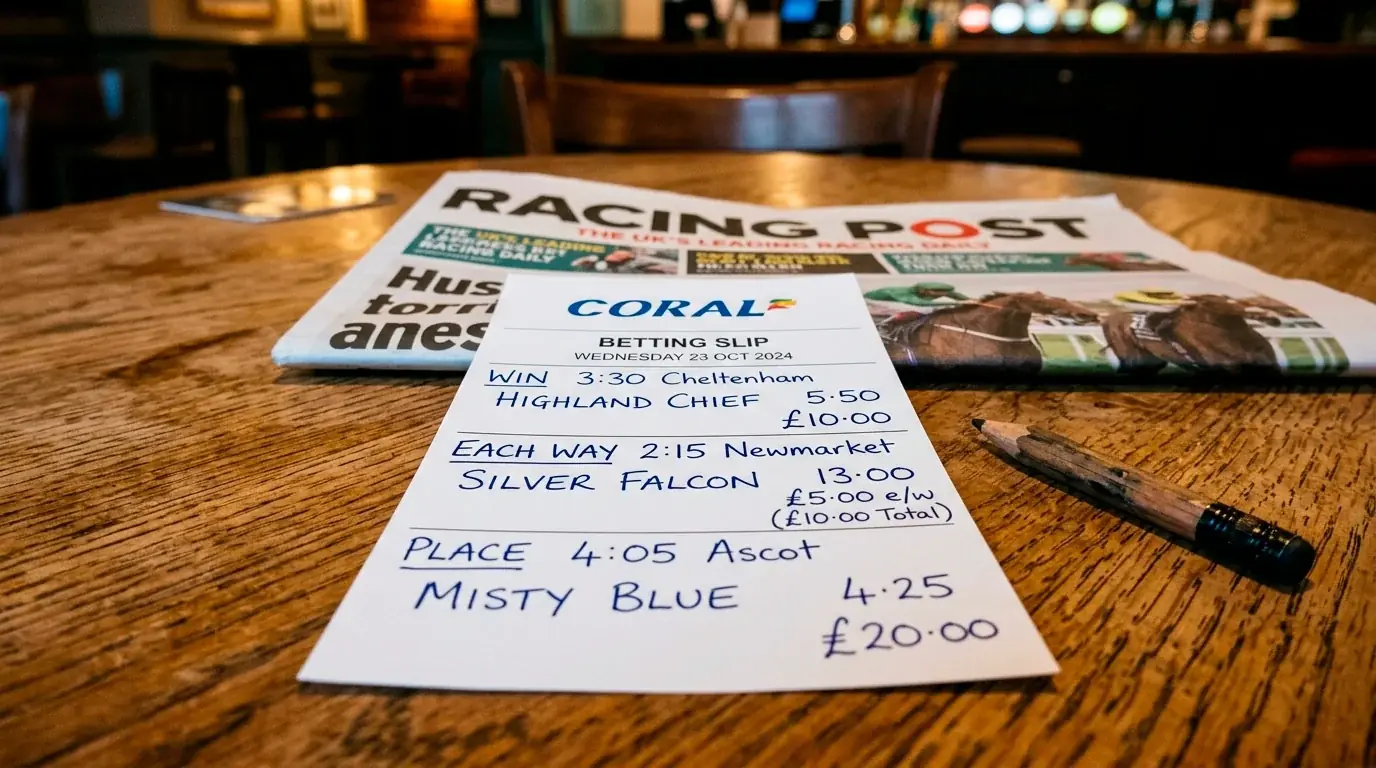
Table of Contents
- Three bets, one race, three different economic animals
- The win-only profile and when it is the right call
- The each-way profile and the field-size pivot
- Place-only — the Betfair Exchange product that found its way into fixed odds
- Free bet compatibility across the three bet types
- Stake allocation logic — choosing between the three
- Reader questions on bet-type selection
Three bets, one race, three different economic animals
A punter on a 10.0 outside shot in a sixteen-runner handicap has three distinct positions available to him, not one. He can back the horse to win, splitting a stake into two halves and getting paid on both win and place, or staking only the place side on markets where that option exists. The same underlying view — “this horse will do well” — expressed three different ways produces three different risk and return profiles, and the decision between them is where a lot of the real craft of UK racing punting lives. Yet most free bet offers treat the three options asymmetrically, with eligibility and settlement mechanics that differ enough to make the wrong bet type genuinely expensive on a token you cannot easily replace.
The underlying field-size data explains a lot of why this matters. The average Premier Fixtures field in 2025 was 11.02 runners for flat racing and 9.41 for jumps — meaningful fields, but not so large that place terms become a free money dispenser. The standard each-way place structure for 16+ runner handicaps pays four places at 1/4 odds. Below that field size, the structure tightens considerably — 8-to-15 runners gets you 3 places at 1/5 odds, 5-to-7 runners gets you 2 places at 1/4 odds, and below 5 runners there are no place terms at all. The field-size pivot is the single most important variable in the each-way decision.
This piece walks through the profile of each bet type, the origin of the place-only market, how free bet compatibility varies across the three options, and the stake-allocation logic I use when choosing.
The win-only profile and when it is the right call
Win-only is the simplest position. Stake goes on, the horse either wins or does not, the settlement is binary. Short-priced favourites are the classic win-only case — a runner at 1.5 does not reward the each-way split meaningfully because the place component pays 1/4 of 1.5, which is an effective price of 1.125 and barely returns the stake. Staking the full amount on the win is more efficient on short prices.
Win-only also makes sense on runners in small fields where no place terms apply. A four-runner non-handicap at Pontefract has no each-way market structurally — place betting is unavailable below five runners in standard UK racing rules — so the only option is win-only if you want the runner. The same applies to two-runner markets, which occasionally happen on weather-affected cards where withdrawals have left a sparse field.
The longer-priced win-only bet is a different animal. A 20.0 runner staked win-only on a £10 free bet pays £200 on a win and zero on a second-or-worse finish. The variance is high and the expected value sits inside a narrow probability band. Most punters are better off splitting a long-priced runner each-way rather than taking the full variance on the win side. But for punters with specific views on runners they expect to win outright — rather than “finish well” — win-only concentrates the expected value efficiently.
The each-way profile and the field-size pivot
Each-way is a stake-splitting structure. A £10 each-way bet is two distinct bets of £5 each — £5 on the win at full odds, £5 on the place at a fraction of the win odds (usually 1/4 or 1/5 depending on race type). The total outlay is £10 but the return profile has two winning outcomes: the runner wins (both win and place pay), or the runner places (only the place pays).
The each-way becomes attractive at prices of 5.0 or higher where the place payout alone can exceed the total stake. A £10 each-way on a 10.0 runner at 1/4 odds pays — on a place finish — £5 × 3.25 = £16.25, already profitable before the win-side is considered. On a win, the combined return is £50 + £16.25 = £66.25 on a £10 stake. The each-way structure converts a long-priced runner from a low-probability binary into a higher-probability hybrid, at the cost of a larger total outlay.
The field-size pivot is where each-way becomes ambiguous. On a 5-to-7 runner race paying 2 places at 1/4 odds, each-way on anything shorter than 6.0 is marginal. The place probability is roughly 2-in-7 on random runners and the place payout is a low multiple of stake. The calculation can tip either way depending on the specific horse. On a 16-runner handicap paying 4 places at 1/4 odds, each-way on anything at 6.0 or higher is almost always correct — the place probability rises to 4-in-16 (25 per cent on random runners, often higher on fancied runners) and the place payout at 1/4 of 6.0+ is meaningful.
Place-only — the Betfair Exchange product that found its way into fixed odds
Place-only betting has an unusual origin. The Betfair Exchange offered place-only markets long before any fixed-odds bookmaker did, because the exchange’s back-and-lay structure handles a place outcome as easily as a win outcome — the market is simply defined on “finishes in a paid place” rather than “wins”. A handful of fixed-odds bookmakers added place-only markets in the 2010s as a way to compete for the part of the punter population that wanted the place outcome without the win-side premium.
The economic proposition of place-only is simple. The full stake goes on the place component, not half. A £10 place-only bet on a 10.0 runner with 1/4 place terms pays £10 × 3.25 = £32.50 on a place finish. Compare with a £10 each-way bet on the same runner at the same price — £16.25 on a place finish (the win portion loses). Place-only pays twice as much as each-way on a placed-not-won outcome, but pays nothing extra on a won outcome, and costs half as much total in place-only-only staking.
The market is offered by Betfair Sportsbook, Paddy Power on selected races, and a small number of other operators. It is not universally available across the UK fixed-odds market. Betfair Exchange offers place-only on essentially every substantial UK meeting. The place-only price is usually derived from the win-market price using a fixed relationship (often the win price divided by approximately three or four, depending on the number of paid places), which means the implied probability structure is coherent with the win market but less advantageous to the punter than backing the place on a lay-the-field exchange position.
Free bet compatibility across the three bet types
Here is where the eligibility matrix gets ugly. Win-only is the most universally-accepted bet type for UK free bets — essentially every operator allows a free bet token to be placed on a win single. Each-way bets are accepted by most operators but with a common quirk: the free bet is treated as the total combined stake, so a £10 free bet placed each-way becomes £5 on the win and £5 on the place, each of them SNR. The effective token value is split between the two components.
Place-only is where compatibility breaks down. Approximately 40 per cent of UK operators explicitly exclude place-only markets from free bet eligibility, treating them as a “specialty market” alongside pool bets and ante-post. Another 30 per cent allow place-only but apply reduced contribution percentages to any wagering requirements downstream. The remaining 30 per cent treat place-only identically to win-only. The variance is wide enough that checking the T&Cs before committing a token is essential.
The operator logic on the place-only exclusion is straightforward. Place-only runners at meaningful prices carry lower variance than win-only bets at the same nominal odds — the hit rate is higher, the payout is smaller, and the expected value of a clean free bet token on place-only tends to be slightly better than on win-only. Bookmakers restrict the markets where the free bet yields above average, and place-only falls into that bucket on most standard handicap structures.
Stake allocation logic — choosing between the three
The decision framework I apply, given a runner I like at price X with available bet types win-only, each-way, and place-only if offered. At prices of 2.0 or shorter, win-only always. The each-way place payout is too small to matter and the place-only option is pricing in barely any value. At prices of 3.0 to 5.0, the choice depends on the race structure — win-only on small fields, each-way on large handicaps. At prices of 6.0 to 15.0, each-way is almost always correct on race types with 3+ paid places, place-only deserves consideration on operators that price it favourably. At prices of 16.0 or longer, each-way is the default on handicaps with 4 paid places, and long-priced singles on small fields deserve a hard look at whether the bet is worth placing at all.
The free bet interaction shifts the calculation. An SNR free bet on a win-only structure extracts the full profit if the runner wins — the asymmetric structure of SNR favours higher-variance bet types because the downside is already bounded by the token being non-returnable. An SNR free bet placed each-way halves the effective token value across two markets, which can make the each-way structure materially less efficient as a free bet deployment than as a cash deployment.
My heuristic on free bet tokens specifically. Win-only on prices of 4.0 to 10.0. Each-way reserved for cash stakes. Place-only on the token only if the operator prices it generously and the runner is in the 6.0 to 10.0 range. This is the inverse of what I do with cash stakes, because the SNR structure changes the efficiency calculus in ways that surprise punters used to thinking in cash terms. The underlying settlement mechanics that make each-way, BOG and Rule 4 interact in non-obvious ways are laid out in detail in my piece on each-way bet settlement rules.
Reader questions on bet-type selection
Can I place a place-only bet on Betfair Sportsbook?
Yes, Betfair Sportsbook offers place-only markets on selected UK racing meetings, separately from the Betfair Exchange place-only markets which are available more universally. Sportsbook place-only prices are derived from the win market using a fixed relationship rather than from independent market-making, so the pricing tends to be less generous than the exchange equivalent on the same runner. Free bet eligibility varies by promotion.
When does a place-only bet pay more than each-way on the same horse?
Always, when the runner places without winning. A £10 place-only bet pays the full stake at place odds, whereas a £10 each-way splits the stake into £5 win plus £5 place and only the place side settles on a placed-not-won finish. On a winning outcome the each-way pays more than place-only because the win component settles as well. Choice between the two depends on the punter’s view of the win-versus-place probability split.
Published by the Free Horse Racing Betting team.