Profit Boosts and Enhanced Horse Racing Odds
 Available in US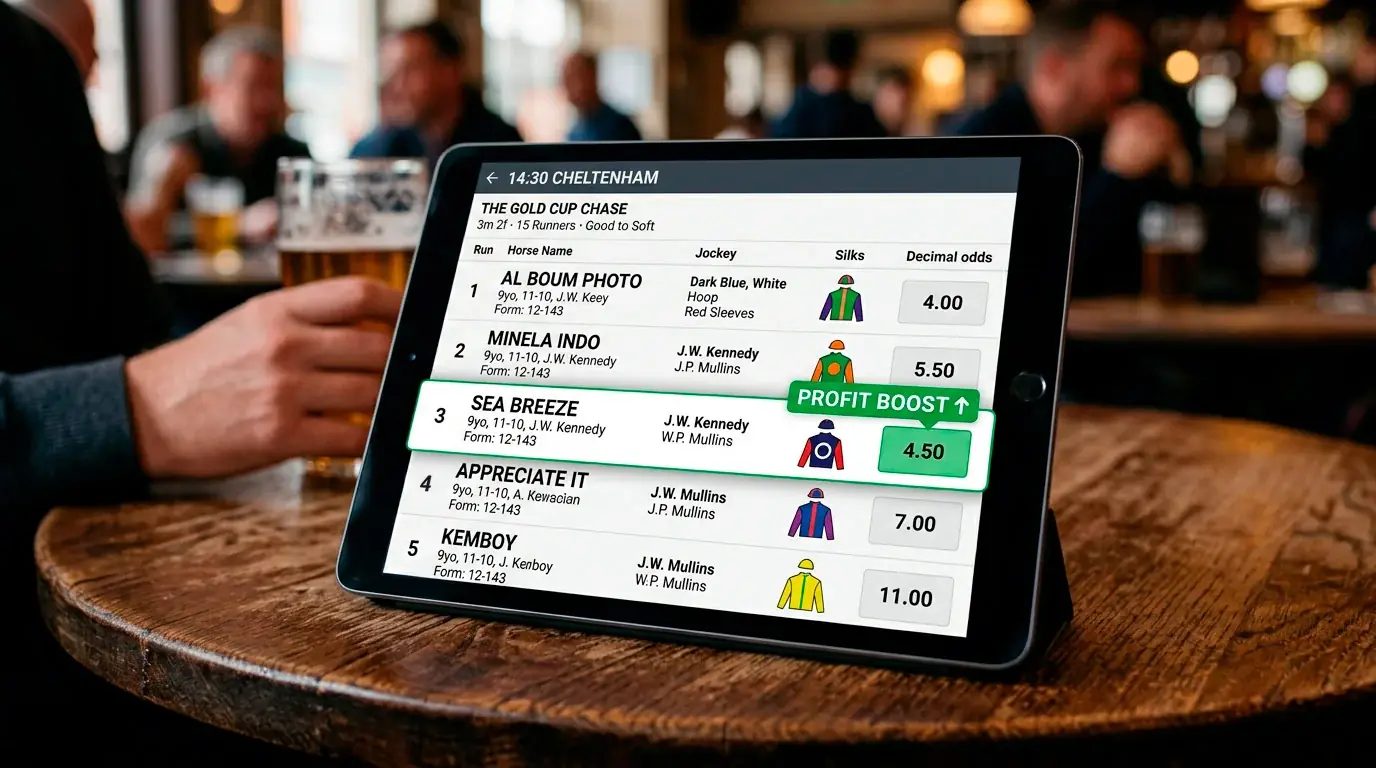
Table of Contents
- Comparing Profit Boosts and Price Enhancements on UK Bookies
- Profit boost mathematics applied to net winnings
- Price boost versus profit boost — a single-number difference
- Super-boosts — the once-a-day showpiece
- Caps, stakes, and the headline-versus-delivered gap
- Choosing between a boost and a free bet on the same race
- Reader questions on enhanced odds promotions
Comparing Profit Boosts and Price Enhancements on UK Bookies
A punter I used to work with once stuck a 25 per cent profit boost on a 3.0 favourite and came away convinced the bookmaker had shortchanged him. He had done the arithmetic by adding a quarter to the price — 3.0 plus 25 per cent equals 3.75, he said. The operator had paid out on 3.5. Who was right? The operator, of course, and not because of any small print. Because “profit boost” and “price boost” are two different promotions with two different formulas, and I watch otherwise-competent punters mix them up every festival.
Neither of these is a free bet and neither is Best Odds Guaranteed. A free bet is a token with nominal face value. BOG is a settlement adjustment — you get whatever price moves in your favour between early morning and the off. A boost is a promotional enhancement applied before the bet is placed, and it bends the odds in one of two mutually exclusive ways. The difference matters because in a typical UK fixed-odds racing market, where the overround sits at 110 to 130 per cent, a boost of the wrong type on the wrong price can be worth less than holding the unboosted odds and placing a £5 free bet instead.
This piece walks through the mechanics of each boost variant, the caps operators apply, and the scenario matrix I use to decide whether a boost or a free bet makes more sense for a specific race.
Profit boost mathematics applied to net winnings
A profit boost uplifts the profit portion of a winning bet by a fixed percentage — typically 10, 20, 30, or 50 per cent, depending on the operator and the promo tier. Crucially, it does not touch your stake. The formula is: stake plus (profit × 1 + boost percentage). If you stake £10 at odds of 3.0 with a 25 per cent profit boost, the profit on a standard bet is £20. The boost adds 25 per cent to that £20, giving £25 net profit, and your return is £10 stake plus £25 profit equals £35. That is the same as being paid at 3.5, not 3.75.
The arithmetic matters more at longer prices. At odds of 5.0 on a £10 stake, raw profit is £40. A 25 per cent profit boost adds £10, paying £60 total versus £50 unboosted. Converted to an effective price, the boosted return equates to 6.0 — the profit boost “stretches” harder on long prices because there is more profit to boost. A flat price enhancement does the opposite.
The profit boost is also the token most operators apply to their super-boost offers on one-off markets, which is where the “50 per cent boost on today’s 4:15 at Ascot” pop-up at 11am usually comes from. The operator has pre-selected a race and a runner where their margin absorbs the boost cost comfortably, and they are pushing it to accounts they want active that afternoon.
Price boost versus profit boost — a single-number difference
A price boost is simpler, and consistently misunderstood. It is a direct uplift to the advertised price, applied before you stake. Morning price is 3.0, price-boosted price is 3.3, punters sometimes think — but that is, again, an additive error. Price boosts are multiplicative on the odds, not on the returns. A “30 per cent price boost” would convert 3.0 into 3.9, and your £10 stake would return £39 on a win.
Operators do not often run 30 per cent price boosts. The more common format is a pre-selected single runner — “3.5 boosted to 4.0 on Field Marshal in the 2:10 at Kempton” — where the operator has shortened and then re-lengthened a price to create a promotional headline without exposing themselves to open-ended liability. The boost size is baked in, the runner is pre-chosen, and your decision is binary: bet it or skip it.
The practical difference between the two boost types comes down to which element of the return is being stretched. Profit boost = winnings enhanced, stake unchanged. Price boost = stake × new price, unified single number. Profit boost is more generous at long prices; price boost is more predictable because you see the final number before clicking.
Super-boosts — the once-a-day showpiece
Super-boosts are operator-curated single offers, usually one per day per operator, on a pre-selected market. They typically take a 2.0 favourite and push it to 3.0 or better — a clearly outsized enhancement that exists because the bookmaker wants foot traffic into their racecard for the rest of the afternoon. The super-boost is a loss-leader in the classic retail sense.
Max stakes on super-boosts are aggressive. I have seen £5 and £10 caps on individual runners where the operator is boosting a price so far beyond fair value that unlimited stakes would bankrupt the promotional budget inside ten minutes. Super-boost stakes do not typically qualify for other promotions — BOG is often suspended on the boosted selection, and a super-boost stake rarely counts towards reload thresholds or loyalty programmes. That last point is the most commonly-missed detail. You might think a £10 super-boost stake would unlock a £5 reload token. On 80 per cent of the operators I have tracked, it does not.
Caps, stakes, and the headline-versus-delivered gap
Every boost runs into two ceilings: the maximum stake you can place on the boosted selection, and the maximum enhancement the operator will actually pay out. The first is the obvious cap — “max stake £25 on this price boost” — and you see it on the promo tile before you commit. The second is subtler. Some operators publish a “max enhancement” figure — £50, £100, £250 — on their profit boost tokens. Beyond that ceiling, the boost stops contributing, so a huge winning stake at long odds no longer benefits proportionally.
The published overround of 110 to 130 per cent on fixed-odds UK racing is the reason these ceilings exist. Boosts erode operator margin, and an uncapped 50 per cent profit boost on a £500 stake at 10.0 would deliver £2,250 of additional winnings on a single bet. No commercial promotions budget survives that once a day. The ceilings are how the operator converts a headline promise — “boost your profit by 50 per cent” — into a manageable marketing line item.
The other cap that trips punters up is the minimum odds floor. Many boosts only fire at 2.0 or higher. A 1.8 favourite, even if boosted to 2.1, does not always qualify for the promotion unless the pre-boost price sits at 2.0 or above. Check the small print before wasting a token.
Choosing between a boost and a free bet on the same race
This is the judgement I make most weekends. Same race, same runner, one token available — boost or free bet? The rule I use is a rough mental heuristic: a profit boost at 25 per cent on a £10 self-funded stake at odds of 5.0 or higher beats a £5 stake-not-returned free bet on the same selection. At shorter prices, the free bet wins. The reason is the interaction between the boost mechanics and the SNR structure — the free bet loses the stake value by design, while the boost preserves it.
When a super-boost gets published, that calculation inverts. A 2.0 pushed to 3.0 on a £10 stake delivers £20 profit versus £10 on the unboosted market. No free bet of typical size — £5, £10, even £15 — beats that on a single event. Take the super-boost. The same logic runs the other way on small boosts at short prices. A 10 per cent profit boost on a 1.8 favourite delivers an £8.80 return on a £10 stake, which is only 80p ahead of the unboosted return — vastly less than a £5 free bet would deliver on the same market.
The intuition I try to teach is: boosts favour long prices, free bets favour short prices, and super-boosts almost always beat free bets on the one race they cover. Everything else is within the margin of error, and the stake size dictates whether the boost cap starts mattering. For the broader architecture of promotions across the UK racing market — how welcome offers, reloads, BOG, and Extra Places fit together — I covered the full picture in the UK free horse racing betting analysis.
Reader questions on enhanced odds promotions
Can a profit boost be combined with a free bet on the same race?
Very rarely. Almost every UK bookmaker specifies that profit boost tokens apply only to cash stakes, not to stake-not-returned free bet tokens. The two promotional mechanics are built on incompatible settlement logic — the boost uplifts profit on a stake, while the free bet has no returnable stake to begin with. Check the specific promo terms before attempting to stack them.
Why are price boosts often limited to specific races or meetings?
Operators control their promotional liability by pre-selecting the runner, the price, and the maximum stake. Opening a price boost to any selection on any race would expose the bookmaker to unlimited adverse selection — sharp punters would find the boosted markets with the worst fair value and stake heavily into them. Curated single-selection boosts cap that risk at a predictable number before the card has even run.
Prepared by the Free Horse Racing Betting editorial staff.