Cash Out Horse Racing Bets and Live Profit Features
 Available in US
Table of Contents
- Securing Live Profits With Partial and Auto Cash Out
- Standard cash out — the buy-back arithmetic
- Partial cash out — withdrawing some stake while leaving the rest
- Auto cash out — the preset threshold
- Free bet cash out block — the universal exclusion
- Cash out versus exchange lay
- Reader questions on mid-race exit mechanics
Securing Live Profits With Partial and Auto Cash Out
Cash out is one of those product features that sounds like the punter’s tool but is actually the bookmaker’s. The mechanic — the operator offers to buy back your existing bet at a derived price, effectively allowing you to lock in a profit or limit a loss before the race finishes — looks like a generous gift from the book. In reality it is a product that sits on top of the operator’s in-running trading, priced to the operator’s margin and almost always economically worse than simply holding the bet to settlement. The casual-punter framing of cash out as “a way to take your winnings early” is misleading; a clearer framing is “a way to pay the bookmaker a premium for certainty you do not actually need”.
Cash out sits against the wider UK racing fixed-odds overround of 110 to 130 per cent and the parallel Betfair Exchange overround of 102 to 105 per cent plus commission. The operator’s cash out pricing is derived from their internal view of the current in-running probability, with an additional margin layered on top to compensate the operator for providing the optional buy-back. That additional margin is where the economic cost of cash out lives for punters, and the cost is typically between 5 and 15 per cent of the bet’s notional value at the moment of cash out.
This piece walks through the buy-back arithmetic, the partial cash out mechanic, auto cash out triggers, why cash out is almost universally blocked on free bet stakes, and the exchange-lay comparison that shows where cash out sits relative to alternative exit routes.
If you plan to trade your position during the race, mastering in-running UK horse racing betting is essential to avoid latency traps.
Standard cash out — the buy-back arithmetic
The cash out mechanic is simply the operator offering to purchase your bet at a price they derive. If you placed a £10 bet at 5.0 on a runner that has, mid-race, moved to a current implied probability equivalent to 2.5, the “fair” cash out value would be around £20 — your £10 stake, carried forward at the probability uplift (from 20 per cent to 40 per cent implied). The operator does not offer £20, however. They typically offer something in the £17 to £19 range, pocketing the £1 to £3 difference as their cash out margin.
The margin calculation runs on the operator’s internal model of current in-running probability. They calculate the value of your bet at that probability, then apply a fixed percentage or absolute-amount deduction for cash out. Some operators publish the cash out “spread” — the difference between cash-in (accepting the buy-back offer) and cash-out (continuing to hold the bet to settlement) — which is typically 3 to 8 per cent. Others hide the margin inside the opaque derived price and make spreads harder to calculate.
The implication. Cashing out on a winning bet captures less expected value than holding to settlement. If your bet is in a strong winning position mid-race, the expected-value maximising decision is almost always to hold. Cashing out pays the operator a premium for removing your exposure to the remaining outcome variance, and the premium is rarely worth paying.
Partial cash out — withdrawing some stake while leaving the rest
The partial cash out variant allows punters to withdraw a portion of their bet while leaving the remainder active. If you placed a £20 bet at 5.0 and the runner is now priced mid-race at equivalent 2.5, you could partial-cash-out £15 of the bet while leaving £5 of the original stake to run to settlement. The £15 withdrawn settles at the current cash out price; the £5 continues to operate as a normal bet at the original odds.
The partial-cash out is typically displayed on a sliding scale. The punter adjusts the proportion of the bet to cash out — 10 per cent, 50 per cent, 90 per cent — and the displayed cash in amount and remaining stake update accordingly. The operator’s margin applies proportionally — a £15 partial cash out includes 75 per cent of the full-cash-out margin.
The strategic use case. Partial cash out is useful when the punter has a strong winning position but wants to reduce their variance exposure to the finish. Withdrawing £15 locks in a baseline profit; leaving £5 allows continued exposure to the full upside. This is a more defensible deployment than full cash out because the punter is trading variance reduction against giving up a smaller chunk of expected value. The cost is still real — the operator’s margin applies to the partial withdrawal — but the framework is more rational than full cash out.
Auto cash out — the preset threshold
Auto cash out is the automated version of the mechanic. The punter configures a target cash out value — “cash out if value reaches £40” — and the operator’s system executes automatically when the threshold is hit during the race. The punter does not need to be watching the market actively; the trigger fires whenever the condition is met.
Auto cash out is popular with punters who cannot watch live racing consistently — betting on multiple simultaneous meetings, attending to the race only briefly, or setting up positions before leaving for other activities. The automation removes the need for manual monitoring while preserving the option to exit at a target profit level.
The operational dynamics. Auto cash out fires the trigger at whichever moment the derived cash out value first reaches the threshold, which may be mid-race at a fleeting price point. The trigger does not wait for confirmation or reassessment; it is immediate. Punters setting aggressive auto-cash-out thresholds (“cash out at £100 on a £20 bet”) may find their bet triggered briefly during a price spike that subsequently reverses, locking in a smaller profit than the race-end settlement would have delivered. The trigger mechanics favour simplicity over optimisation.
Free bet cash out block — the universal exclusion
The critical point for free-bet-focused punters. Almost every UK operator blocks cash out on stake-not-returned free bet positions. The operational reason is the SNR structure — the stake component is non-returnable by design, and cash out is fundamentally a stake-recovery-plus-profit-lock product. Without a returnable stake, the cash out mathematics does not operate cleanly.
Lewis, former CSO of evoke and a panellist at the 2026 Illegal Gambling Prevention Summit, framed the broader regulatory context in which these feature-exclusions sit: “If we were to think of a scenario where we could make the black market more attractive, I’d struggle to come up with much more that we could do. All of these sweeping changes over the last five years have just made a huge difference to the industry — affordability, banning credit cards, limits on VIPs, limits on auto spins and now the tax changes.” Cash out exclusion on free bets is part of the same regulatory-plus-commercial landscape — features are restricted to manageable risk profiles, which means free bet tokens sit outside features like cash out that complicate operator liability tracking.
The punter-side experience. A free bet deployed on a runner that moves into a strong winning position mid-race cannot be cashed out — the cash out button is greyed out, or the attempt returns an error message. The punter must either hold to settlement or accept the loss of the token. There is no early-exit option.
This matters for how free bets should be deployed. On bets where the underlying probability mix means holding to settlement has a wide variance of outcomes, a cash-stake bet offers the flexibility of mid-race exit via cash out. A free bet on the same runner forces the punter to accept the full variance without recourse. The structural implication is that free bets should typically be deployed on positions where the punter is genuinely comfortable with the full-settlement outcome distribution, rather than positions where mid-race exit strategies might be valuable.
Cash out versus exchange lay
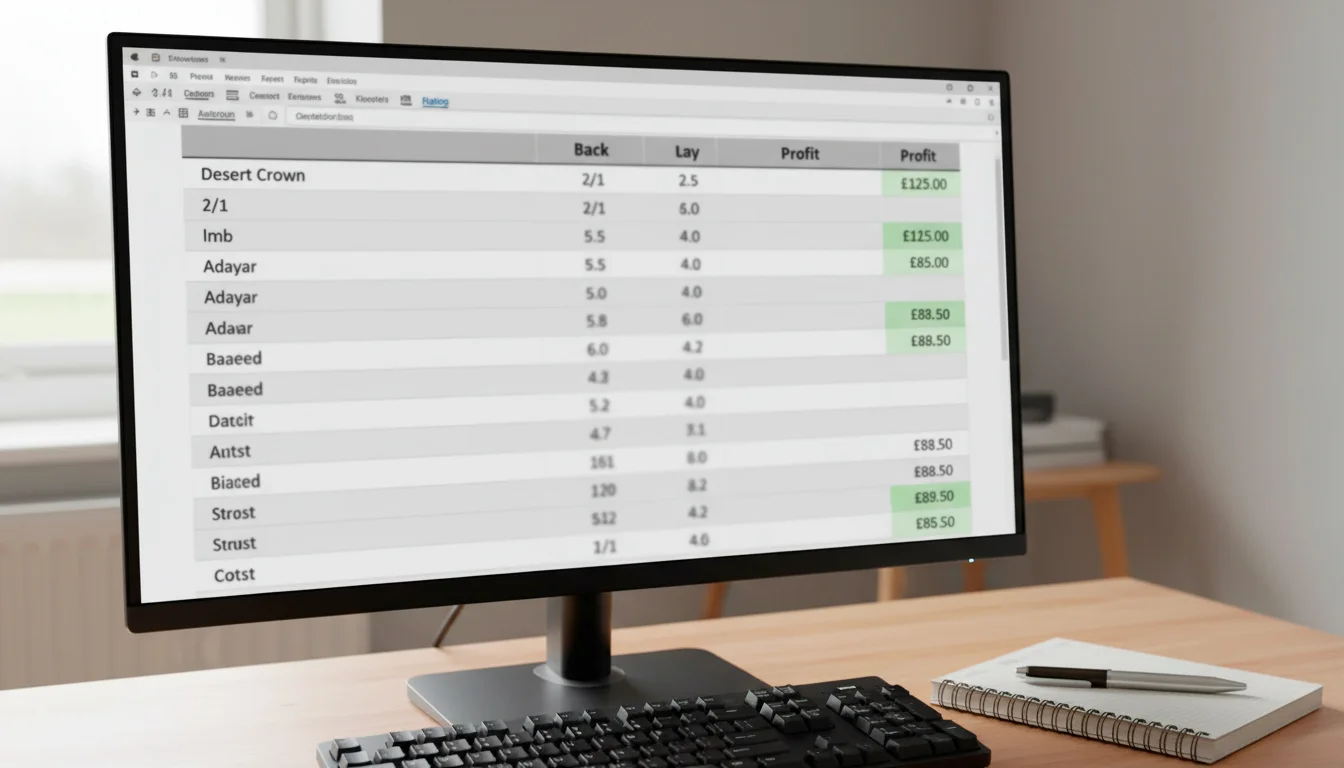
The alternative to cash out on the exchange is placing a lay bet against your back bet on the Betfair Exchange. If you backed a horse at 5.0 on a bookmaker and it is now 2.5 in-running on the exchange, a £20 lay at 2.5 on the exchange approximately offsets your £10 back bet, locking in a profit.
The arithmetic. Original back at 5.0 with £10 stake — potential profit £40 if win, potential loss £10 if lose. Lay at 2.5 on exchange with appropriate stake to match — if the horse wins, exchange loss offsets bookmaker gain to net a calculable profit. If the horse loses, bookmaker loses stake, exchange wins laid stake, net position calculable. The exchange lay provides a structural hedge that leaves the punter with a calculable net profit regardless of outcome.
The comparison to cash out. Exchange lays typically capture 95 to 98 per cent of the fair-value profit on a strong-position mid-race bet, versus the 85 to 92 per cent that cash out captures. The exchange hedge has substantially tighter margins because the exchange’s 102 to 105 per cent overround plus commission is significantly less than the operator’s cash out margin on top of their already-thicker in-running prices.
The execution friction. Exchange lays require a separate exchange account, sufficient exchange balance, and the ability to place lay stakes quickly during the race. Cash out requires only a button press. The friction difference means recreational punters usually default to cash out; professional punters usually default to exchange lays. The economic difference over a career of mid-race exits is material — a 5 per cent wedge on every exit compounds across hundreds of positions. How exchange execution and fixed-odds cash out compare across the full market — not just in-running but at the pre-off and settlement stages — is the subject of my piece on the Betfair Exchange versus UK bookmakers comparison.
Reader questions on mid-race exit mechanics
Why can’t I cash out a bet that was placed with a free bet token?
Cash out is fundamentally a stake-recovery-plus-profit-lock product, and stake-not-returned free bets have no returnable stake component by design. The cash out arithmetic does not operate cleanly on SNR positions — the operator cannot buy back stake that was never your stake to begin with. Essentially every UK licensed operator blocks cash out on free bet positions as a universal policy, and the block is enforced operationally at the cash out interface rather than being a post-hoc settlement adjustment.
How much of the profit does a UK bookmaker typically keep on a cash-out offer?
Operator cash out margins typically run 5 to 15 per cent of the fair-value position, depending on the specific operator, the time-in-race, and the market liquidity. On a winning-position mid-race bet, the operator’s cash out offer is reliably below the exchange-implied fair value of the bet, with the gap representing the operator’s margin for providing the early-exit service. The margin is larger when the bet is in a strong winning position and smaller when the position is marginal, reflecting the operator’s variance-management cost in each case.
Prepared by the Free Horse Racing Betting editorial staff. Learn how to protect your stakes and manage your bankroll with Free Horse Racing Betting.