Best UK Horse Racing Bookmakers and Betting Sites
 Available in US
The word “best” is the first thing I distrust on any list of UK bookmakers. Best by what measure? Best for the writer’s affiliate split? Best at paying the click, not the punter? I have spent seven years watching operators move up and down the rankings in affiliate lists without any observable change in product quality — only in commercial terms. The genuine question is not “which bookmaker is best” but “which bookmaker is safe, solvent, and operating within the regulatory perimeter that gives your winnings legal force.” That is the audit that matters.
The UK regulatory landscape gives you a clean baseline. There are 3,086 active gambling licences in Britain at the most recent count, down 2.3% on the prior year. Those licences are issued and policed by the Gambling Commission, and any operator offering betting to UK customers without one is operating illegally. The black-market tail is growing fast — traffic to 22 unlicensed sites specifically accepting UK racing bets rose 522% between August 2021 and September 2024 — and the sites dressing themselves up as “UK bookmakers” in search results are not always UK bookmakers at all.
This piece is a licence-first audit framework. I do not rank operators, and I do not recommend specific brands. What I do instead is give you the seven-point methodology I use privately to decide whether an operator earns my deposit. The framework weights regulatory standing far more heavily than promotional headlines, because the cost of getting the regulatory side wrong is catastrophic and the cost of getting the promotional side wrong is a tenner.
Keep in mind that all licensed operators will eventually require you to complete KYC and Source of Funds checks to verify your account.
Table of Contents
- Verifying UKGC Licenses for Safe Horse Racing Bookmakers
- The seven-point audit framework I run on every operator
- How to verify a UKGC licence in five minutes
- Product depth: what a serious UK racing operator actually covers
- Comparing how operators handle Extra Places, BOG, and NRNB timing
- App quality and race punctuality as operational signals
- Customer protection measures that separate compliant from excellent operators
- Red flags: the markers of a problematic operator
- The bookmaker audit as a five-minute discipline, not a one-time decision
Verifying UKGC Licenses for Safe Horse Racing Bookmakers
Most punters treat the UKGC licence as a tick-box afterthought — a footer badge on the website, a line in the small print. That reverses the real priority. The licence is the binding legal relationship between you and the operator. It is the mechanism by which winnings become enforceable, complaints become actionable, account closures become appealable. Without it, your account is a customer-service courtesy, not a contract.
Consider what the licence guarantees in practice. The operator must segregate customer funds — roughly £1.0bn is currently held across UK operator accounts on behalf of customers under this requirement. The operator must comply with the advertising code, meaning headline offers must be truthfully represented. The operator must implement affordability and safer-gambling controls. The operator must cooperate with Independent Betting Adjudication Service (IBAS) or equivalent dispute resolution. The operator must file suspicious-activity reports. None of these obligations exist on an unlicensed operator. None.
The black-market alternative is not theoretical. An estimated 1.5m British customers stake up to £4.3bn a year on unlicensed gambling — around £2.7bn online and up to £1.6bn offline. The online share is growing, driven by frustration with affordability checks on the licensed side and marketing saturation from offshore operators offering bigger nominal bonuses. Andrew Rhodes at the Gambling Commission has framed the regulatory view directly: the illegal online market is unsafe, unfair and criminal — and the Commission has invested heavily in counter-measures in recent years. The regulator’s position is unambiguous, but the onus on verifying any given operator falls on the customer.
The practical implication is simple. If a site you are considering is not UKGC-licensed, the promotions it offers have no legal force. A £100 welcome offer is what the operator says it is until they decide otherwise. Winnings are payable when the operator decides to pay them. Accounts are closeable at the operator’s discretion. You can neither appeal nor enforce. The promotional headlines on unlicensed sites are consistently more generous than on licensed ones, and they should be. They are worth less because they are unenforceable.
There is a recurring failure mode I see among smart, numerate punters: they treat licence verification as a one-time check at sign-up, then forget about it. Licences are revoked. Operators change ownership. Brand names are acquired by different licensees. A site that was UKGC-licensed when you opened an account in 2022 may be operating under a different structure in 2026. Re-verify annually, and immediately if you notice a change in branding or payment processing.
The seven-point audit framework I run on every operator
I learned this framework the hard way, one bad experience at a time. Each point addresses a specific failure mode I have seen play out.
Point one: UKGC licence verification. The operator must have a valid licence number on its website footer, and that number must resolve correctly on the Gambling Commission’s Register of Licensees. Not the operator’s own page about licensing — the Commission’s live register. If the site redirects the licence link elsewhere, or displays a number that does not match, the verification fails.
Point two: operator age and track record. How long has the entity held its licence? New licences are not inherently suspect, but a three-month-old operator with aggressive welcome offers and unfamiliar payment processing is a different risk profile from a fifteen-year-old operator with a stable licence history. I set my baseline at three years of continuous UKGC licensing before I consider a welcome offer seriously.
Point three: UK customer volume. The remote sector currently holds around 24.4m active customer accounts across casino, betting and bingo. The major UK operators each hold customer bases in the millions. A legitimate UK operator with meaningful racing product has a customer volume large enough to support industry data reporting, media coverage, and independent review. A claimed UK operator with no discoverable customer base outside its own marketing is a red flag.
Point four: promotional transparency. Can you find the full T&Cs for every advertised promotion within two clicks of the home page, in plain English, without a login? The advertising code requires this, and compliant operators meet the standard easily. Promotional pages that hide material terms behind “learn more” links, unclear exclusions, or login-gated small print fail this test.
Point five: affordability practices disclosure. Compliant UK operators now disclose, at minimum, the thresholds at which they will request documentation — income verification, source of funds, betting history review. They do not always disclose the algorithm, but they disclose the triggers. An operator that claims “no affordability checks ever” is misrepresenting its regulatory obligations, and that misrepresentation should concern you more than an operator that openly explains when and why checks apply.
Point six: payout record. Industry reputation for paying out disputed winnings is not visible on the operator’s own site, but it is visible through independent review aggregators, IBAS case logs, and longstanding punter community discussion. A pattern of slow pays, account limits on winning customers, or adjudicated disputes against the operator is a meaningful signal. A clean record is not a guarantee, but it is a necessary condition.
Point seven: product depth on UK racing specifically. A general sports operator with a thin racing section — limited markets, no ante-post, no exchange pricing, no each-way on smaller fields — is not the same thing as a racing-specialist operator even if both hold UKGC licences. For a punter who bets racing regularly, product depth translates directly into available value. A bookmaker that offers BOG from 8am on every UK meeting is a different animal from one that offers BOG only on selected ITV races.
The framework is additive. An operator can score well on some points and badly on others. My personal threshold for taking a welcome offer seriously is strong scores on points one, two, four, and six — licence, history, transparency, payout record. Points three, five and seven shape which operators are preferable among the qualifiers, not which ones clear the bar. No amount of promotional generosity substitutes for a failure on the first four.
How to verify a UKGC licence in five minutes
The verification process is simpler than most punters assume. Every UKGC-licensed operator must display its licence number on the website. The number is typically in the footer, in small type, often alongside text like “licensed and regulated by the Gambling Commission.” Sometimes it appears on a dedicated “Licensing” or “About” page. Find the number before you deposit.
Take that number to the Commission’s Register of Licensees — a public database maintained at register.gamblingcommission.gov.uk. Enter the number or the operator name. The register will show you the full legal entity name, the scope of the licence (remote casino, remote betting, remote bingo), the date issued, any conditions attached, and any regulatory actions the Commission has taken. The date issued is the date to check against the operator’s marketing claims about longevity — “20 years of trusted service” on a licence issued in 2022 is a warning sign.
Match the legal entity name on the register to the name displayed on the website. Operators frequently trade under brand names that differ from their registered legal name. The brand is the marketing; the legal entity is the counterparty. If the brand you are depositing with cannot be traced back to a licensed legal entity, you are not dealing with a UKGC-licensed operator. This happens more often than it should — a white-label brand sitting on top of a non-UK parent, for example, or an offshore operator using a UK brand name for SEO purposes.
Check for regulatory actions. The Register lists formal sanctions: fines, licence conditions, suspensions. An operator with a clean record is the baseline; an operator with a recent significant fine should prompt you to read the published decision before continuing. The Commission publishes its regulatory decisions in full, with the operator’s conduct, the remediation required, and the sanction applied. These documents are highly informative and freely accessible. They tell you what the regulator actually thinks of the operator’s practices, not what the operator says about itself.
If anything in this five-minute check fails — the number does not resolve, the entity name does not match, the scope of the licence does not cover what you are being offered — close the tab. There is no promotional offer in the UK market large enough to compensate for depositing with an unverified counterparty. The Commission maintains the register specifically so that customers can run this check. Not running it is a choice.
Product depth: what a serious UK racing operator actually covers
The remote betting sector in the UK generated £2.6bn of gross gaming yield in the most recent reporting year, with around £1.3bn from football and £766.7m from racing. Racing is the second-largest sport by handle but the operators who treat it as a secondary product are obvious in their market coverage. Product depth is where the audit moves from regulatory compliance to practical utility.
The minimum I expect from a serious UK racing operator is full UK and Irish meeting coverage with all win, each-way, and multi-race markets. That is the baseline. Above the baseline, the differentiators are: ante-post markets on the major festivals, released early (January for Cheltenham, February for Grand National, April for Royal Ascot); international racing on at least a selective basis (France, US, Hong Kong, Australia for the major meetings); specials and novelty markets (distance-of-winning, winning colours, Queen’s winner at Royal Ascot); and live streaming of at least the Premier Fixtures and major festivals.
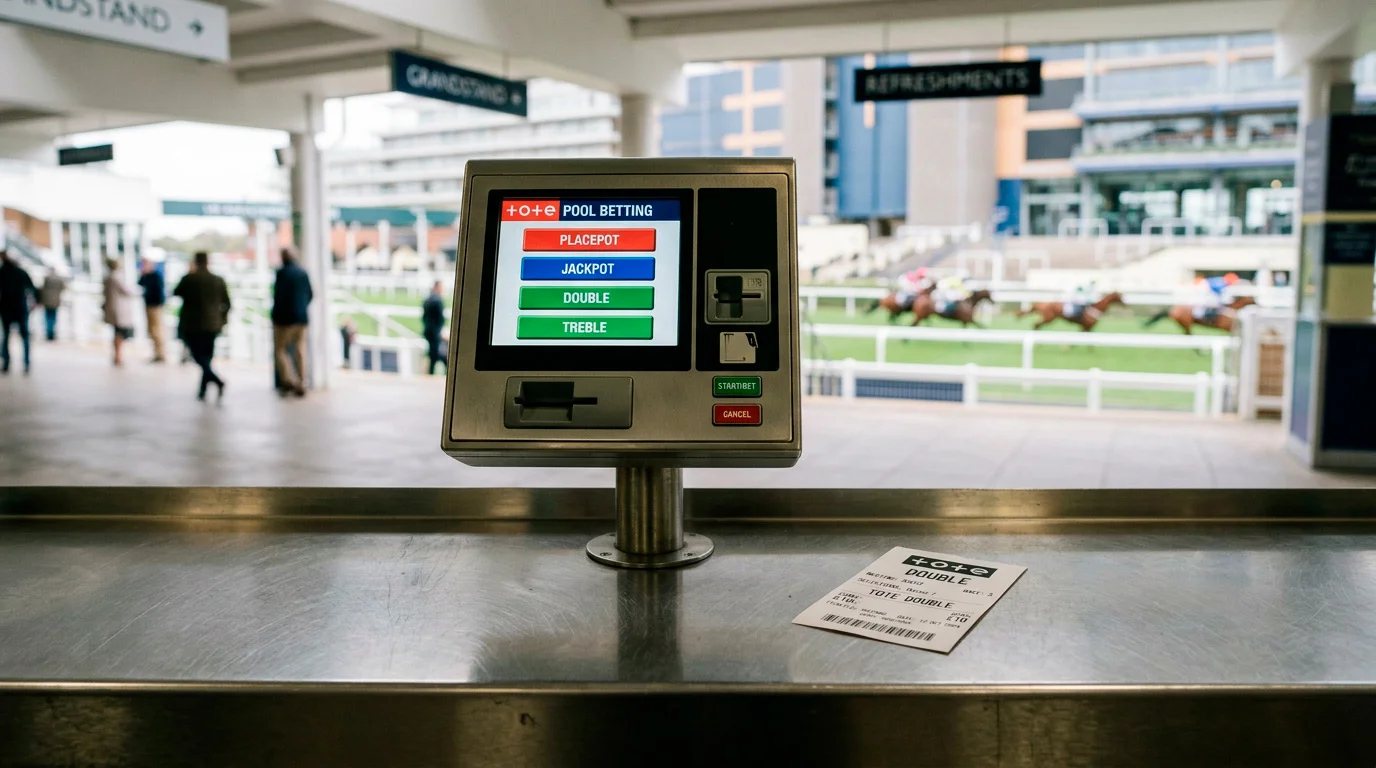
Placepot and multi-race pools are a specific product layer that separates specialists from generalists. The Placepot — pick one horse to place in each of the first six races at a meeting — is a Tote product, and operators either carry it properly or do not. Scoop6, Jackpot, and Quadpot products are similarly specialist inventory. A bookmaker that does not offer Placepot is not a disqualifier — many excellent operators concentrate on fixed-odds product — but its absence should prompt a secondary question about product fit.
Exchange and fixed-odds integration is the other product-depth axis. An operator offering only fixed-odds is operating on 110-130% overround on UK racing markets. An operator offering access to exchange prices, or running a hybrid product that allows lay bets alongside back bets, exposes customers to 102-105% markets with commission applied to net profit. The two products are not substitutes — exchange punters need a different mental model and a different staking discipline — but the availability of both inside one account is a serious convenience for punters who use both.
The product depth question loops back to the promotional question. An operator with thin product depth and heavy promotional spending is usually a customer-acquisition play rather than a serious racing proposition. An operator with deep product and moderate promotional spending is typically a longer-term relationship. My tokens go to the second group. Welcome bonuses get spent once; product depth matters every week.
Comparing how operators handle Extra Places, BOG, and NRNB timing
Promotional policy is where operators actually differentiate on UK racing. Every licensee covers the core markets; what varies is when and how they extend the protections. A useful audit here looks at four variables: BOG activation time, Extra Places base terms, NRNB activation schedule, and enhanced-price publication frequency.
BOG activation time is the first. The standard industry practice is BOG from 10am or from the first race of the day. A meaningful minority of operators activate BOG from 8am, which covers the early morning board moves that matter during festival weeks. During Cheltenham 2026, bet365’s BOG liability ran to around £50m across four days — and Sky Bet’s Extra Places liability hit £10m over the same period. Those figures represent cash paid out, and they scale with activation timing and extension generosity. An operator that activates BOG at 10am is handing you fewer basis points of protected upside than one activating at 8am, on the same race, at the same nominal odds.
Extra Places base terms matter even outside festival weeks. The industry baseline is 4 places at 1/4 on 16+ runner handicaps. Some operators extend to 5 places as a standing term across all such handicaps — effectively a structural Extra Place that applies 52 weeks a year rather than just festival weeks. Others reserve extensions strictly for named festival events. The standing-5 operators offer marginally more value on ordinary Saturday racing at the cost of slightly less aggressive festival-week promotion. It is a trade-off to be aware of.
NRNB activation is the ante-post variable. Operators split on when they switch NRNB on for major events. Grand National NRNB typically activates between early March and late March depending on operator; Cheltenham NRNB between early February and mid-February; Royal Ascot in the first week of June. An operator that activates NRNB two weeks earlier than a competitor is giving you an extra two weeks of protected ante-post exposure. Over a festival calendar, that difference compounds meaningfully.
Enhanced-price publication frequency is the fourth variable. Some operators publish a daily enhanced price on at least one featured race, consistently, across the UK calendar. Others run enhanced prices only on weekend featured races or festival days. For a punter who bets midweek as well as weekends, the daily-publication operators offer structurally more promotional touch-points. The value per enhanced price is small — typically a 10-20% price boost on a selected horse — but the frequency matters.
App quality and race punctuality as operational signals
Operational quality is the quiet signal that separates genuinely well-run operators from ones that look good in the brochure. The BHA’s Q1 2025 Racing Report recorded 87.6% of races starting within two minutes of the scheduled time — a meaningful improvement on 79.2% in 2024 and 72.7% in 2023. That punctuality metric matters to operators because in-running markets, BOG activation windows, and race alert notifications all depend on accurate time data flowing through their systems.
An operator’s app quality on race-day is the punter-facing expression of that operational pipeline. Alerts that fire when your selected horse is about to go into the stalls. BOG settlements that appear in your balance within 60 seconds of the official result. Cash-out offers that refresh accurately during in-running. Stream quality that does not stutter during the final two furlongs. These are not cosmetic features — they are the operational substrate on which your betting experience sits.
Testing an operator’s app before you commit bankroll is a twenty-minute exercise. Install the app. Navigate to a race happening within the hour. Add a small selection to a virtual slip without placing the bet. Check the flow: how many taps to confirm a stake, how clearly the price appears, how easily you can switch to an each-way option. Do the same for cashing out a small pre-existing bet. An operator whose app is slow or confusing on these basic flows is not one whose settlements you want to trust on festival Saturday.
A small detail that is surprisingly diagnostic: how quickly does the app settle a race after the photo? Good operators settle within 30-90 seconds of the official result. Lagging operators can take 5-15 minutes, especially on competitive finishes or races with stewards’ enquiries pending. The settlement speed during Cheltenham Thursday tells you more about the operator’s technical depth than any marketing page does.
Live streaming availability is the other app-side consideration. Most UK operators now stream Premier Fixtures and major festivals, but coverage varies on non-Premier meetings. Some require a bet on the relevant race to unlock streaming; others offer free streaming on funded accounts. If live coverage matters to you — for reading ground, spotting horse behaviour in the paddock, watching for late rider instructions — confirm the streaming policy before committing.
Customer protection measures that separate compliant from excellent operators
Customer protection is where the licensed regulatory framework and the operator’s own standards intersect. Every UKGC licensee must provide self-exclusion, deposit limits, reality checks, and session time limits. These are baselines. The variation across operators is in the quality of implementation — how easy the limits are to set, how strictly the operator enforces them, and whether the operator goes beyond the regulatory minimum.
Deposit limit implementation is the first test. Compliant operators let you set a deposit limit (daily, weekly, or monthly) at any time, apply it immediately, and require a waiting period before you can increase it. A waiting period of 24 hours is the regulatory minimum. Some operators voluntarily apply longer periods — 48 or 72 hours — on limit increases, reflecting a stronger commitment to protecting customers from impulsive changes. The seven-day “cool-down” period that appears on some platforms is a voluntary extension beyond the regulatory minimum.
Loss limits and time-spent tracking are the next tier. Beyond deposit limits, some operators offer loss limits (capping total losses across a period rather than deposits), session time limits, and aggregate activity dashboards. These tools cost the operator in engagement metrics — a punter who hits their loss limit stops betting — and their presence signals an operator that takes protection seriously beyond the compliance floor.
The customer fund segregation requirement is invisible to most punters but matters in a specific failure mode. UKGC licensees must hold customer funds separately from operating funds, with the sector-wide total around £1.0bn. If the operator becomes insolvent, segregated customer funds are protected to some extent depending on the segregation rating. “Basic” is the minimum; “medium” and “high” offer progressively stronger protections. The Commission publishes the rating on the Register. A “high” rating is a meaningful comfort; “basic” is a meaningful warning.
Safer-gambling tools matter because they exist at the point of friction. The Commission’s strategic framing — articulated by Andrew Rhodes — is that a significant part of the regulatory effort is to target interventions as far upstream as possible, at the level of hosts, payment providers, software providers, search engines and others. The customer-facing tools are the downstream expression of that strategy. An operator that invests in sophisticated upstream monitoring — behavioural triggers, spending-pattern analysis, voluntary intervention — is doing work that does not appear in a welcome-offer headline but matters substantially over the course of a customer relationship.
Red flags: the markers of a problematic operator
Some signals are stronger than others. A single red flag is reason to look more carefully; several together are reason to walk away. One in five 18-24 year old bettors has already used unlicensed operators at least once — which tells you the unlicensed sector is not a distant problem but a live alternative that dresses itself up in UK-looking branding. The red flags below are the markers I watch for.
Flag one: unverifiable licence. The site claims regulation but the licence number does not resolve, or resolves to a different legal entity, or shows a licence scope that does not cover what the operator is offering. This is disqualifying on its own.
Flag two: implausibly large welcome bonuses. A “£500 welcome bonus” or “100% up to £1,000” headline from a site with thin product depth and limited operating history is almost certainly an unlicensed operator using inflated numbers to capture click-through. Yield Sec analysis suggests illegal operators earned around £379m in the first half of 2025 from UK customers, and the pattern is concentrated at the high-stake end where bonus inflation is the hook. If the headline offer is three times what established licensed operators advertise, the operator is outside the regulatory perimeter.
Flag three: payment processing through obscure channels. Legitimate UK operators accept debit card, bank transfer, and a curated set of digital wallets (Apple Pay, Google Pay, PayPal subject to exclusions). An operator that routes payments through unfamiliar payment processors, cryptocurrency channels, or third-party e-wallets with no UK consumer-protection footprint is flagging its non-UK nature regardless of what the branding says.
Flag four: aggressive closure of winning accounts. Every operator limits stakes on consistently winning customers — that is a commercial reality, not a red flag in isolation. The red flag is closure or restriction without documented reason, often on customers who have used welcome offers and then transitioned to normal betting. A pattern of this behaviour on an operator is visible through independent review sources and IBAS case records. Widespread recent complaints on this pattern is a reason to avoid.
Flag five: opaque ownership structure. UK-licensed operators trade under brand names that map cleanly to registered legal entities, which in turn map to parent companies with known ownership. An operator whose ownership structure is multiple layers of offshore vehicles, or whose “About Us” page is evasive about the underlying legal entity, is giving you a warning in advance. Grainne Hurst at the Betting and Gaming Council has been explicit about the scale of the black-market challenge: parasite operators don’t pay tax, don’t care about safer gambling, and don’t contribute to the Levy. The sites behind the more opaque ownership structures are the ones doing the parasitic work, and the nominally generous welcome offers are the lure.
For the broader context on how licensed operators fit into the UK market structure — including Levy economics, affordability dynamics, and the festival-week promotional machinery — the pillar analysis on UK free horse racing betting connects the regulatory picture to the punter-facing product.
The bookmaker audit as a five-minute discipline, not a one-time decision
Running the seven-point audit on every operator you use, and re-running the licence verification annually, is a small discipline that protects the overwhelming majority of what matters. The promotional layer — welcome offers, Extra Places extensions, BOG activation times, enhanced prices — sits on top of the regulatory layer, and the regulatory layer is what determines whether your winnings are real and your dispute-resolution path is functional. Five minutes of licence verification at account opening, and another five minutes annually to confirm continued standing, is the cheapest insurance available to a UK punter.
The UK market in 2026 gives you a large set of genuinely good options once you have cleared the regulatory bar. Thirty-plus UKGC-licensed operators offer competitive racing product, active BOG policies, and reasonable promotional cadence. Which one is “best” for you is a product-fit question — field coverage, app quality, streaming policy, promotional mix — not a universal ranking question. Clear the licence bar first. Decide on fit second.
How do I verify a bookmaker’s UKGC licence?
Find the operator’s licence number on the website footer. Go to the Gambling Commission’s Register of Licensees at register.gamblingcommission.gov.uk. Enter the number or operator name. Check that the legal entity name on the register matches the branding on the site, the licence scope covers what the operator is offering, and there are no recent regulatory actions against the licence. The whole check takes about five minutes and should be run at account opening and re-run annually.
What should I do if a UK-licensed bookmaker refuses to pay out?
First, request the operator’s written reason for withholding payment. Every UKGC licensee is required to provide this in writing. Second, escalate through the operator’s internal complaints procedure, which must be published on the website. If the dispute is not resolved within eight weeks, escalate to an alternative dispute resolution provider — usually IBAS (Independent Betting Adjudication Service) for betting disputes. IBAS decisions are binding on the operator if you accept them. If the operator refuses to engage with IBAS or fails to comply with a decision, the case can be escalated to the Gambling Commission as a regulatory matter.
Are affiliate ‘top 10’ bookmaker lists reliable?
Affiliate lists rank operators by commercial arrangement with the writer, not by independent assessment. An operator pays to be ranked; the ranking reflects the commercial relationship rather than product quality. This does not mean every operator on an affiliate list is bad — many are perfectly legitimate UKGC-licensed businesses — but the ranking tells you nothing about which is better than the others. The useful approach is to treat affiliate lists as a starting point for your own verification: check the licence on each operator, run the audit framework, and make a decision on product fit rather than affiliate ranking.
Which UK bookmakers offer the longest Best Odds Guaranteed window?
BOG activation windows vary by operator. Most UK licensees activate BOG from 10am on the day of the race, or from the first race of the day if earlier. A meaningful minority activate from 8am, which covers the early morning board moves that matter during festival weeks. A few operators extend BOG from the previous evening for Saturday racing. The longest-window operators are usually specialist racing bookmakers rather than general sports operators. Check the operator’s BOG page directly — the timing is published as part of the promotion T&Cs.
Published by the Free Horse Racing Betting team. Read comprehensive reviews and secure the best sign-up offers at Free Horse Racing Betting.